Content options
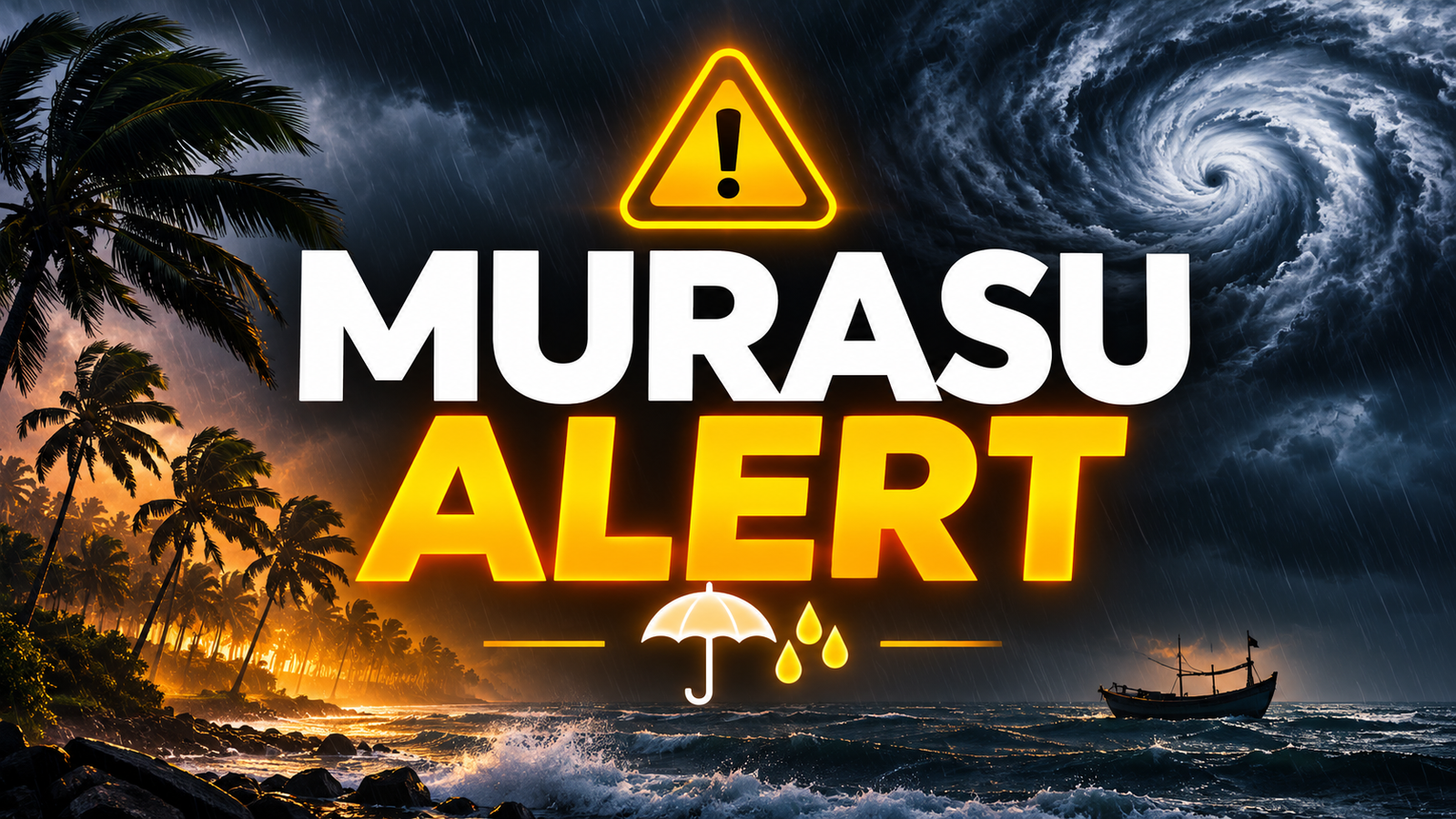
Cyclone Murasu is the name reports are using for a possible cyclone building from a low-pressure area over the Bay of Bengal. According to Malayalam news reports citing the India Meteorological Department (IMD), Kerala has heavy rain and strong wind in the forecast, with a yellow alert for four districts today. A yellow alert means "be aware": it is not an evacuation order, but it is a signal to check your plans and keep watching official updates.
This guide explains what those words mean, so you can read the next IMD bulletin yourself instead of relying on a headline.
Key takeaways
- A yellow alert is the second-lowest level in IMD's four-colour system. It asks you to stay informed and prepared, not to panic.
- A low-pressure area becomes a named cyclone only after it strengthens through several stages. Not every low does.
- Kerala sits on the west coast, so a Bay of Bengal system usually reaches it as rain and gusty wind rather than a direct landfall.
- Check your district's alert colour from IMD or the state disaster authority, and keep phones charged, documents dry and drains clear.
What do the reports say about Cyclone Murasu?
The reports we have seen say three things. A low-pressure area has formed over the Bay of Bengal. It comes soon after another cyclone, Arnab, and IMD has issued a warning. Kerala has a yellow alert for four districts today because of expected heavy rain and wind.
What the reports do not settle is where the system will go or how strong it will become. Those details change from one bulletin to the next. Treat any track map or wind-speed figure on social media with caution until you see it on IMD's own page.
How do cyclones get their names?
Cyclones in the north Indian Ocean are named from a pre-agreed list. Countries around the region, working through the World Meteorological Organization's panel on tropical cyclones, each contributed names. Forecasters then use them in order, so nobody has to improvise.
The point of a name is clarity. Saying "Murasu" is easier and less error-prone than saying "the system near 13 degrees north, 85 degrees east", especially when several systems are active. Names also make warnings easier to remember and share.
Murasu is believed to be one of the names proposed by India, and the word is said to mean a drum in Tamil (origin and meaning to be confirmed against the official name list). Arnab is believed to be a Bangladesh-contributed name (confirm against the official list).
A system gets a name only when it reaches cyclonic storm strength, meaning sustained winds of about 62 km/h or more. Until then, it is just a low or a depression, and it has no name.
What does a low-pressure area over the Bay of Bengal mean for Kerala?
A low-pressure area is a region where air pressure at the surface is lower than its surroundings. Air rises there, clouds build and rain follows. Over warm sea water, such a low can organise and strengthen.
IMD describes the climb in stages, as in the table below.
| Stage | Typical sustained wind | What it means |
|---|---|---|
| Low-pressure area | Below 31 km/h | Cloud and rain, no organised circulation yet |
| Depression | 31 to 49 km/h | Closed circulation, rain bands forming |
| Deep depression | 50 to 61 km/h | Stronger, close to cyclone strength |
| Cyclonic storm | 62 to 88 km/h | Gets a name, such as Murasu |
| Severe cyclonic storm and above | 89 km/h and higher | Damaging winds, storm surge risk on coasts |
For Kerala, the geography matters. A storm in the Bay of Bengal normally moves towards the east coast of India or Myanmar and Bangladesh. Kerala is on the opposite side of the peninsula, so the direct wind threat is lower than for Odisha, Andhra Pradesh or Tamil Nadu.
But the effects can still reach the state. Large systems can disturb wind patterns and pull moisture across the peninsula, which gives Kerala spells of heavy rain and gusty winds. Heavy rain on the Western Ghats slopes can also trigger landslides, and low-lying areas can flood. That is why a rain alert can matter even when the cyclone itself is far away.
For more on how larger climate patterns shape seasonal rainfall, see our explainer on El Nino and household water.
What does a yellow alert from IMD actually mean?
IMD uses four colours for district-level warnings. The colour reflects both how severe the weather may be and how much impact it could have.
| Colour | Meaning | What you should do |
|---|---|---|
| Green | No warning | Nothing special |
| Yellow | Be aware | Keep checking forecasts, review your plan |
| Orange | Be prepared | Get ready to act, avoid unnecessary travel |
| Red | Take action | Follow official instructions, move if told to |
A yellow alert for rain generally goes with "heavy" rainfall in IMD's wording, which means roughly 64.5 to 115.5 mm in 24 hours. Very heavy rain is 115.6 to 204.4 mm, and extremely heavy is above that.
A worked example: what 80 mm of rain looks like
Rain depth is measured in millimetres, and 1 mm of rain over 1 square metre equals 1 litre of water. So 80 mm in a day is 80 litres on every square metre.
Take a house with a roof and terrace of 100 square metres. That is 80 x 100 = 8,000 litres landing on your roof in 24 hours, roughly the capacity of eight large 1,000-litre water tanks. If gutters, terrace outlets or nearby drains are blocked, that water has nowhere to go. This is why clearing drains is on the checklist below.
Which Kerala districts are under alert today?
The reports mention four districts under a yellow alert today. We are not listing them here because alerts are updated through the day, and a stale list could mislead you.
Check your district on the IMD website (mausam.imd.gov.in) or its Thiruvananthapuram centre's bulletin, and follow the Kerala state disaster management authority's updates. District collectors also post local instructions, such as school closures or restrictions on beach and hill travel.
Cyclone preparedness checklist for Kerala households
You do not need a bunker. You need a few hours of sensible preparation. Do these things while the alert is still yellow.
Before the rain intensifies
- Charge phones and power banks, and keep one phone for emergency use only.
- Put ID cards, property papers, insurance documents and medical prescriptions in a waterproof pouch.
- Clear drains, gutters and terrace outlets near your home.
- Store drinking water for at least a day or two, plus dry food that needs no cooking.
- Keep a torch, spare batteries, basic first-aid supplies and any regular medicines in one bag.
- Note the number of your local control room and keep 112, India's emergency number, handy. Kerala district control rooms are often reached on 1077.
While it is raining and windy
- Stay indoors, away from windows, and keep out of flooded roads and fast-moving water.
- Do not shelter under old trees, hoardings or near electric poles.
- Switch off the mains if water enters your home, and do not touch wet wiring.
- If you live near a hillside or river, move early if local officials ask you to, rather than waiting.
After the weather passes
- Avoid fallen power lines and report them to the electricity board.
- Boil or treat drinking water if supply is muddy or the tank was submerged.
- Photograph any damage before cleaning up, for insurance or relief claims.
Heavy rain and storms can also push up the price of vegetables and fish for a while. Our explainer on what inflation is shows how such supply shocks reach your monthly budget.
Common mistakes people make during weather alerts
- Waiting for red. By the time a red alert arrives, roads may be cut off and shelters crowded. Yellow is the time to prepare.
- Trusting forwarded maps. Old satellite images and fake tracks circulate quickly. Use IMD or state authority pages.
- Driving through water. Even 30 cm of moving water can float a small car, and you cannot see what is under the surface.
- Ignoring fishermen's warnings. If you work at sea or live in a coastal village, follow the "no fishing" advisories strictly. They are issued for good reason.
- Relying on one phone. Networks can fail. Keep a battery radio or agree a meeting point with family.
Myth vs fact: cyclone alerts
| Myth | Fact |
|---|---|
| A yellow alert means a cyclone is hitting your district. | It means weather that needs awareness, such as heavy rain or strong wind. It can occur without any cyclone. |
| Every low-pressure area becomes a cyclone. | Many weaken or stay as rain-bearing depressions. |
| If the cyclone is in the Bay of Bengal, Kerala is safe. | Direct landfall is unlikely, but rain, wind and landslide risk can still reach the state. |
| The name shows how dangerous it is. | Names come from a list in order. They say nothing about strength. |
Frequently asked questions
Is Cyclone Murasu going to hit Kerala?
Reports describe a Bay of Bengal low that may develop into a cyclone, with Kerala expecting heavy rain and wind. Kerala is on the west coast, so a direct landfall from a Bay system is not the usual pattern. Follow IMD's latest bulletin for the track.
What is the difference between yellow, orange and red alerts?
Yellow asks you to be aware, orange asks you to be prepared and red asks you to take action. Authorities may restrict travel or open shelters at orange and red levels.
How is a cyclone named?
Names come from a list agreed by countries in the region. A system receives the next name only once it reaches cyclonic storm strength, with winds of about 62 km/h or more.
Where can I check the Kerala rain alert for my district?
Use IMD's website and its regional bulletins, and watch for updates from the Kerala state disaster management authority and your district collector. For national guidance on preparing, the National Disaster Management Authority publishes advice at ndma.gov.in.
Can my phone help during a cyclone?
Yes, for alerts, maps and calls, as long as it is charged and the network is up. Satellite navigation is improving too, and our piece on NavIC and your phone explains one Indian system. Keep a paper note of key numbers as backup.
Bottom line
For most people in Kerala, a yellow alert is a cue to prepare calmly, not to worry. Today, check your district's colour on the IMD site, clear your drains, charge your devices and pack your documents in a waterproof pouch. If the alert moves to orange or red, follow local officials without delay.