Content options
For most of human history, weather was something you endured, not engineered. Farmers prayed for rain. Cities flooded without warning. Droughts lasted years. The sky did what it wanted, and humanity adapted. But that story is changing — slowly, unevenly, and with enormous controversy.
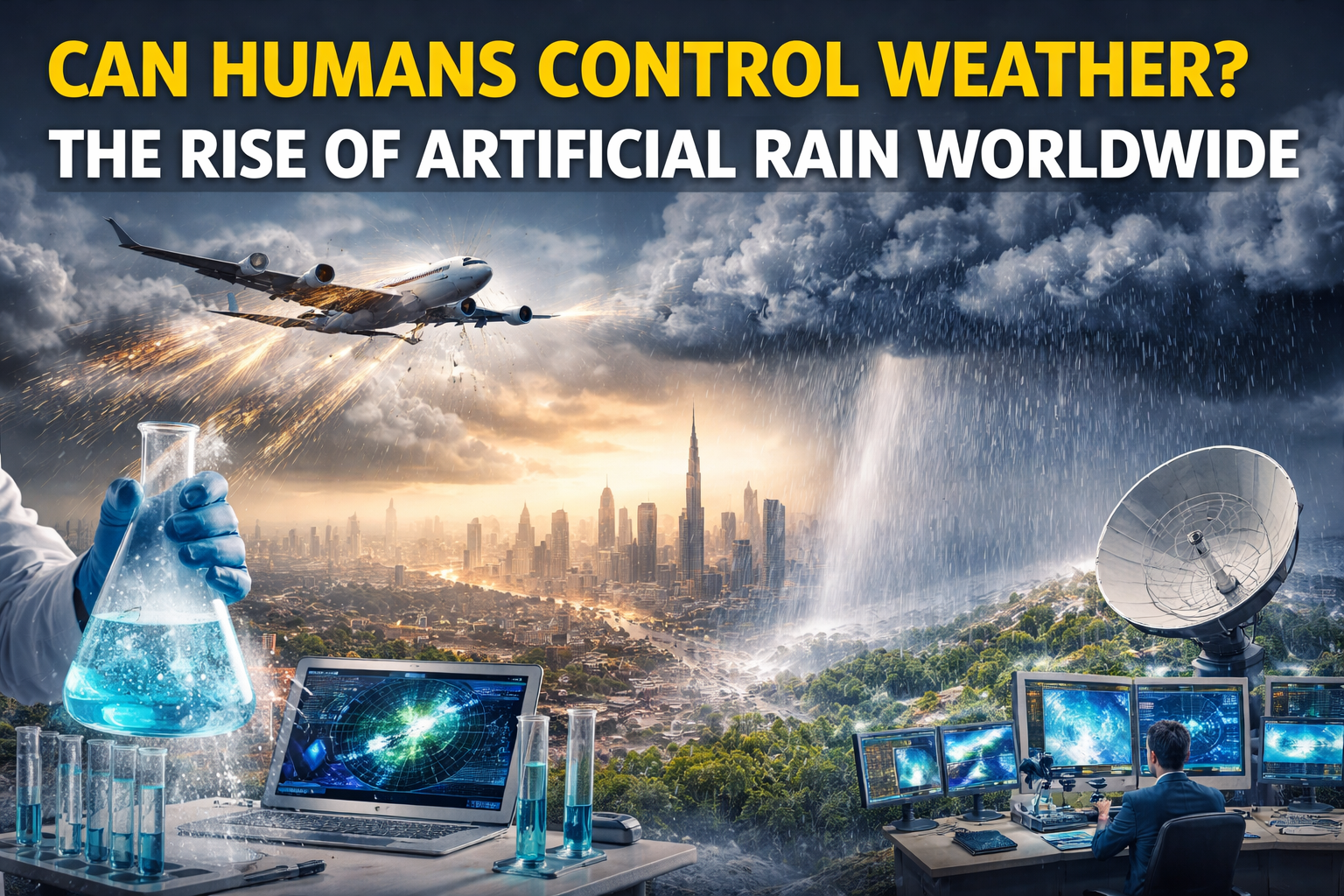
Today, more than 50 countries around the world are actively experimenting with or operating weather modification programs. Governments are spending hundreds of millions of dollars to seed clouds, redirect rainfall, clear fog, and suppress hailstorms. China fires rockets into the sky to make it rain over crops. Dubai sends drones into thunderclouds to trigger downpours in the desert. India dropped silver iodide over Delhi hoping to wash away pollution. The United States seeds mountain snowpack to fill reservoirs for millions of people.
The technology is real. The ambition is growing. And the questions it raises — scientific, ethical, and geopolitical — are among the most important of our time.
A Brief History: When Did Humans First Try to Make It Rain?
The desire to control rain is as old as civilization itself. Ancient cultures performed rain dances, built temples, and made sacrifices to weather gods. But the scientific attempt to actually engineer rainfall is surprisingly recent.
1946 The birth of cloud seeding
American chemist Vincent Schaefer, working at General Electric, discovers that dropping dry ice pellets into a cold cloud causes ice crystals to form and fall as snow. It is the first successful deliberate weather modification experiment in history.
1947 Silver iodide enters the picture
Schaefer's colleague Bernard Vonnegut — brother of novelist Kurt Vonnegut — discovers that silver iodide is even more effective than dry ice as a cloud seeding agent due to its ice-like crystal structure. Silver iodide remains the most widely used seeding chemical in the world today.
1967 Operation Popeye: Weather as a weapon
The United States military secretly uses cloud seeding over Vietnam to extend the monsoon season and flood supply routes used by North Vietnamese forces. The operation lasts five years and seeds thousands of clouds. It is one of the first uses of weather modification as a military weapon.
1976 The world responds with a treaty
The United Nations passes the Environmental Modification Convention (ENMOD), prohibiting hostile military use of weather modification. However, the treaty has significant gaps — it does not cover accidental transboundary effects or civilian programs that inadvertently impact neighboring countries.
2008 China seeds clouds before the Olympics
Beijing fires over 1,100 rain-dispersal rockets in the days leading up to the Summer Olympics opening ceremony to ensure clear skies over the stadium. It is the most high-profile use of weather modification for event planning in history and puts China's program firmly in the global spotlight.
2025 A global boom in artificial rain programs
The cloud seeding market reaches USD 428.6 million. New players including Cyprus, Kazakhstan, Romania, and Bulgaria announce or expand programs. US startup Rainmaker grows from 19 to 120 employees in a single year. India conducts its first Delhi cloud seeding trial. The era of mainstream weather modification has officially arrived.
How Does Cloud Seeding Actually Work?
The science behind weather modification sounds simple on paper but is deceptively complex in practice. Cloud seeding works by introducing particles into existing clouds that act as nuclei — tiny anchors around which water vapour can condense and freeze into ice crystals, which then grow heavy enough to fall as rain or snow.
There are three main techniques used around the world today.
| Technique | How It Works | Best Used For | Used By |
|---|---|---|---|
| Static glaciogenic seeding | Introduces silver iodide into cold clouds to trigger ice crystal formation | Increasing mountain snowpack and winter precipitation | USA, Australia, Russia |
| Hygroscopic seeding | Releases salt particles into warm clouds to accelerate droplet growth | Triggering rain in tropical or warm-climate regions | UAE, Thailand, South Africa |
| Dynamic seeding | Releases large quantities of seeding agents to dramatically boost convective clouds | Large-scale rainfall enhancement and drought mitigation | China, India (trial) |
| Electric charge method | Uses drones to release electrical charges that stimulate cloud droplet coalescence | Desert regions with shallow clouds and limited moisture | UAE (experimental) |
| Ground-based generators | Stationary silver iodide generators release particles that rise naturally into clouds | Mountain orographic clouds over specific watersheds | USA (Utah, Wyoming), Switzerland |
Country by Country: Who Is Leading the Weather Control Race?
The world's weather modification programs vary enormously in scale, ambition, and results. Here is a detailed look at the countries making the biggest moves.
China — The World's Weather Superpower
China Meteorological Administration operates the world's largest weather modification program. Over 1,100 aircraft, 1,100 rockets, and thousands of ground-based generators cover a territory of 5.5 million square kilometres — nearly twice the size of India. Between 2012 and 2017, China reported increasing rainfall by a staggering 316 billion tons through artificial weather interventions. In 2020, Beijing announced plans to expand the program to 10.4 million square kilometres by 2025. China uses weather modification not just for agriculture and water supply but also to suppress hailstorms that damage crops, clear air pollution over cities, and even generate snow for ski resorts. The 2008 Olympics demonstration was just the most visible example of a program that operates year-round, at industrial scale, across the entire country.
UAE — The Desert Rain Pioneer
The United Arab Emirates has been cloud seeding since 1990, making it one of the longest-running programs in the world. The National Centre of Meteorology conducts over 1,000 hours of seeding flights every year. In 2023, the UAE completed over 300 cloud seeding missions. Government reports claim a 10 to 35 percent increase in rainfall in targeted areas, though independent verification remains a challenge. The UAE has also partnered with NASA and the National Centre for Atmospheric Research for its research program. More recently, the country has pioneered the use of electrical charge drones to stimulate rainfall from shallow desert clouds, a technique that does not require chemical agents. Dubai and Abu Dhabi have integrated weather modification into their long-term water security strategies and plan to double seeding capacity by 2026.
United States — Quiet Leader in the West
The United States has operated cloud seeding programs under the Weather Modification Reporting Act of 1972, primarily in western states facing chronic water shortages. Utah now runs the world's largest remote-controlled cloud seeding program. Wyoming has operated continuous seeding since 2005 over mountain ranges that feed major rivers. The University of Wyoming demonstrated a 6 percent snowfall increase over seven winter seasons. The US Bureau of Reclamation committed USD 2.4 million to expand operations in California and Nevada through 2025. US startup Rainmaker, which focuses on snowpack augmentation, grew from 19 to 120 employees in a single year, signalling growing private sector investment in the technology.
Thailand — The Royal Rainmaking Nation
Thailand's Royal Rainmaking Project, initiated in 1955 under royal patronage, is one of the oldest operational programs in the world. Thailand developed its own multi-stage "Super Sandwich" cloud seeding technique that uses hygroscopic chemicals to first build cloud mass, then enlarges droplets, and finally triggers precipitation. The program addresses drought, forest fires, and air pollution, and it has earned international recognition as a model for sustainable weather modification in tropical climates. Thailand's approach is widely studied by developing nations in Southeast Asia looking to establish their own programs.
India — Promise Mixed with Challenges
India operates cloud seeding programs across multiple states including Karnataka, Maharashtra, Andhra Pradesh, and Telangana, primarily for agricultural drought mitigation during weak or delayed monsoons. Results have been inconsistent. Some years show measurable rainfall increases in target zones; others show no effect due to the absence of suitable clouds. India's most high-profile recent experiment — the October 2025 Delhi cloud seeding trial conducted with IIT Kanpur at a cost of Rs 3.2 crore — produced no measurable rain because cloud moisture was only 15 to 20 percent, far below the 50 to 60 percent required. India's meteorological institutions agree that cloud seeding has legitimate agricultural uses but is not suitable as an emergency urban pollution fix.
Australia — Powering Hydro with Rain
Australia has one of the most uniquely applied cloud seeding programs in the world. Tasmania's Hydro Tasmania has operated seeding since the 1960s, using increased rainfall from the Snowy Mountains and highlands to generate an estimated 30 gigawatt-hours of additional electricity annually. The Snowy Mountains Cloud Seeding Trial, which ran from 2009 to 2024, demonstrated a consistent 6 percent increase in snowfall. The Australian government funded a USD 5 million cloud seeding research program in 2023 to enhance water security for its agricultural regions, which face increasingly severe drought cycles.
Emerging Programs: Indonesia, Malaysia, Saudi Arabia
Indonesia uses cloud seeding in Jakarta to redirect rainfall from flood-prone areas toward the sea. In March 2025, provincial agencies conducted flights over the Jakarta coastline at around USD 12,000 per flyover. Malaysia has operated cloud seeding since 1988 to fill reservoirs, fight haze, and manage forest fires. Saudi Arabia received four specialized King Air 360 aircraft in June 2024 for its National Center for Meteorology seeding program, as part of a broader water security investment in the Gulf region.
Success vs Failure: What Does the Evidence Actually Say?
Supporters of cloud seeding point to decades of operational use across 50 countries as proof that the technology works. Critics argue that evidence for its effectiveness is far weaker than governments admit. The truth, as usual, sits somewhere in between — and depends heavily on the context.
| Application | Evidence of Success | Limitations |
|---|---|---|
| Mountain snowpack augmentation | Strong. Wyoming 7-season study shows 6% increase. Utah remote program shows consistent results. | Requires orographic clouds (clouds formed over mountains). Hard to scale to flatlands. |
| Agricultural drought relief | Moderate. Thailand and UAE report meaningful improvements. Some Indian state programs show results. | Requires suitable cloud cover, which is often absent during the worst droughts. |
| Urban air pollution control | Weak. Delhi 2025 produced no rain. No peer-reviewed study confirms sustained urban pollution reduction. | Winter urban skies are too dry. Pollution returns immediately after rain. Doesn't address root causes. |
| Hail suppression for crops | Moderate. Bulgaria, Romania, and North American programs show some hailstorm reduction. | Scientific proof at cloud scale is still limited. WMO notes more research needed. |
| Event weather management | Strong for prevention. China's 2008 Olympics, Moscow holiday operations show reliable results. | Works best for fog dispersal and preventing existing rain, not creating rain from scratch. |
Most studies suggest cloud seeding may increase precipitation by only 5 to 15 percent compared to what would happen without it. It does not cause a significant increase in precipitation. And the weather naturally varies so much that proving the seeding effect is genuinely difficult.
Kara D. Lamb, Associate Research Scientist, Columbia University Earth and Environmental Engineering, 2025The Ethical Storm: Should Humans Control Weather?
The scientific debate over cloud seeding's effectiveness is actually simpler than the ethical debate over whether it should be done at all. As weather modification programs grow more sophisticated and more widely adopted, a set of profound moral and geopolitical questions is beginning to demand answers.
Arguments For Weather Control
- Can save lives and livelihoods during extreme droughts
- Provides water security for populations in arid regions
- Can reduce wildfire risk by increasing moisture in drought areas
- Less harmful than unchecked climate change effects
- Potential to augment clean energy generation via hydropower
- Relatively low chemical concentrations with minimal health risks per WMO
Arguments Against Weather Control
- One country's rain may become another's drought
- No international body governs transboundary weather effects
- Rich nations can afford it; poor nations may suffer consequences
- Risk of false accusations, geopolitical tensions, and weather wars
- Long-term ecosystem disruption from repeated chemical use
- Creates false sense of security, delaying real climate action
The Geopolitical Risk: Weather Theft and Cloud Wars
Perhaps the most alarming ethical dimension of weather modification is its potential to generate international conflict. In 2018, an Iranian general publicly accused Israel of "stealing clouds" to prevent rain from falling in Iran during a severe drought. The accusation was not scientifically substantiated, but it reflects a growing anxiety about weather sovereignty.
China's massive weather modification program on the Tibetan Plateau raises legitimate concerns from downstream countries including India. The Tibetan Plateau feeds the major rivers of South and Southeast Asia. If China's seeding operations systematically redirect moisture away from natural precipitation patterns, the effects could cascade through water supplies that hundreds of millions of people depend on. There is currently no international framework that would require China to consult its neighbors before conducting large-scale weather operations.
Who Owns the Rain?
The question of who owns rainfall — or who has the right to create it — has no legal answer today. National laws vary enormously, and international frameworks barely address the issue. The World Meteorological Organization (WMO) neither promotes nor discourages weather modification. It encourages scientifically sound research and best practices but does not enforce standards or arbitrate disputes.
The American Meteorological Society has warned that unintended consequences of cloud seeding have not been clearly shown or clearly ruled out, and that unanticipated effects could cross political boundaries. French writer Mathieu Simonet has even campaigned for clouds to receive UN protection, arguing that shared atmospheric resources deserve the same international governance as shared ocean resources.
The New Frontier: Beyond Cloud Seeding
Cloud seeding, while growing rapidly, is only the beginning of humanity's ambitions to engineer weather and climate. A new generation of much larger-scale interventions is being researched — and debated with equal intensity.
- Solar Radiation Management (SRM): This technique involves injecting sulfate aerosols into the stratosphere to reflect sunlight away from Earth, theoretically reducing global temperatures. It is controversial because the effects would be global, potentially irreversible, and would not address ocean acidification from CO2. Columbia University's Kara Lamb notes that SRM cannot simply cancel out the effects of warming — the atmosphere is far more complex than that.
- Fog collection technology: Nets and surfaces designed to capture moisture from fog for drinking water are being deployed in coastal regions of Chile, Morocco, and South Africa as a low-tech but effective local alternative to cloud seeding.
- Drone-based electrical seeding: The UAE's pioneering use of electrically charged drones to stimulate cloud droplet growth without chemical agents represents a cleaner evolution of traditional seeding, with potential for more precise and controllable results.
- Atmospheric water generation: Technology that extracts water directly from humid air at the household or community level, bypassing weather manipulation entirely and offering distributed water security without geopolitical risk.
- Infrared laser cloud seeding: Experimental research into using high-powered laser pulses to ionize air molecules and trigger condensation in clouds. Still at laboratory stage but represents a fully chemical-free path to precipitation enhancement.
What This Means for India Specifically
India stands at a unique crossroads in the weather modification story. It has the agricultural need, the scientific institutions, and the climate variability that make cloud seeding genuinely useful for specific applications. But it also carries the risk of deploying the technology beyond its proven limits.
The use cases where cloud seeding can legitimately help India include augmenting monsoon rainfall over rain-fed agricultural regions during drought years, increasing reservoir levels during water-scarce summers in peninsular India, and managing forest fire risk by increasing moisture in dry zones. These are real, measurable applications that Indian meteorological agencies have been working on for decades.
Where India goes wrong is in reaching for cloud seeding as a quick fix for urban pollution — a problem that requires structural solutions, not atmospheric ones. The Rs 3.2 crore spent on the Delhi trial in October 2025 would have had far greater impact redirected toward stubble management subsidies for farmers in Punjab, electric vehicle incentives, or industrial emission enforcement. India has world-class atmospheric science expertise at IITM Pune, IIT Kanpur, and the Indian Meteorological Department. The challenge is not scientific capacity — it is political will to deploy that capacity where it actually works.
Frequently Asked Questions
1. Can humans really control the weather with current technology?
2. Which country has the most advanced artificial rain technology?
3. Is cloud seeding safe for humans and the environment?
4. Can cloud seeding cause flooding?
5. What are the ethical concerns about countries controlling rainfall?
6. What is the future of weather modification technology?
7. Why did Dubai experience heavy flooding if cloud seeding was being used there?
The Verdict: Power Without Full Understanding Is Dangerous
Humanity is undeniably entering a new era in its relationship with weather. The technology to influence precipitation is real, growing, and accelerating. From China's massive rocket-and-aircraft program to the UAE's drone innovations to Wyoming's quiet mountain snowpack operations, weather modification has moved from science fiction into operational reality.
But the gap between what we can do and what we fully understand about the consequences is still enormous. We can nudge clouds. We cannot control storms. We can enhance rain in suitable conditions. We cannot create it where nature refuses. And we can trigger geopolitical tensions — even wars of words and accusations — without meaning to, simply by seeding a cloud that someone else was counting on.
The most honest answer to the question "Can humans control weather?" is this: We can influence it, in limited ways, in specific conditions, with uncertain side effects and no international rulebook. That is not the same as control. And mistaking influence for control — as Delhi's October 2025 experiment illustrated perfectly — is how expensive mistakes get made.
The future of weather modification will be shaped not just by science but by governance, equity, and the willingness of the international community to treat the atmosphere as a shared resource rather than a tool for national advantage. For now, we are still learning — and the sky is watching.
For more deep-dive coverage on environmental technology, global science stories, and the issues shaping our climate future, keep reading BlogofTime.com — where complex stories are told in language everyone can understand.