Content options
Every winter, Delhi wakes up inside a cloud it did not choose. A thick grey blanket of smog wraps around 40 million people, stings their lungs, blurs their skyline, and sends thousands to hospitals with breathing problems. The air quality index regularly crosses 400 and sometimes touches 500, a level that health experts describe as equivalent to smoking 10 cigarettes a day. And every winter, the government reaches for a new tool to try and fix what decades of policy have failed to prevent.
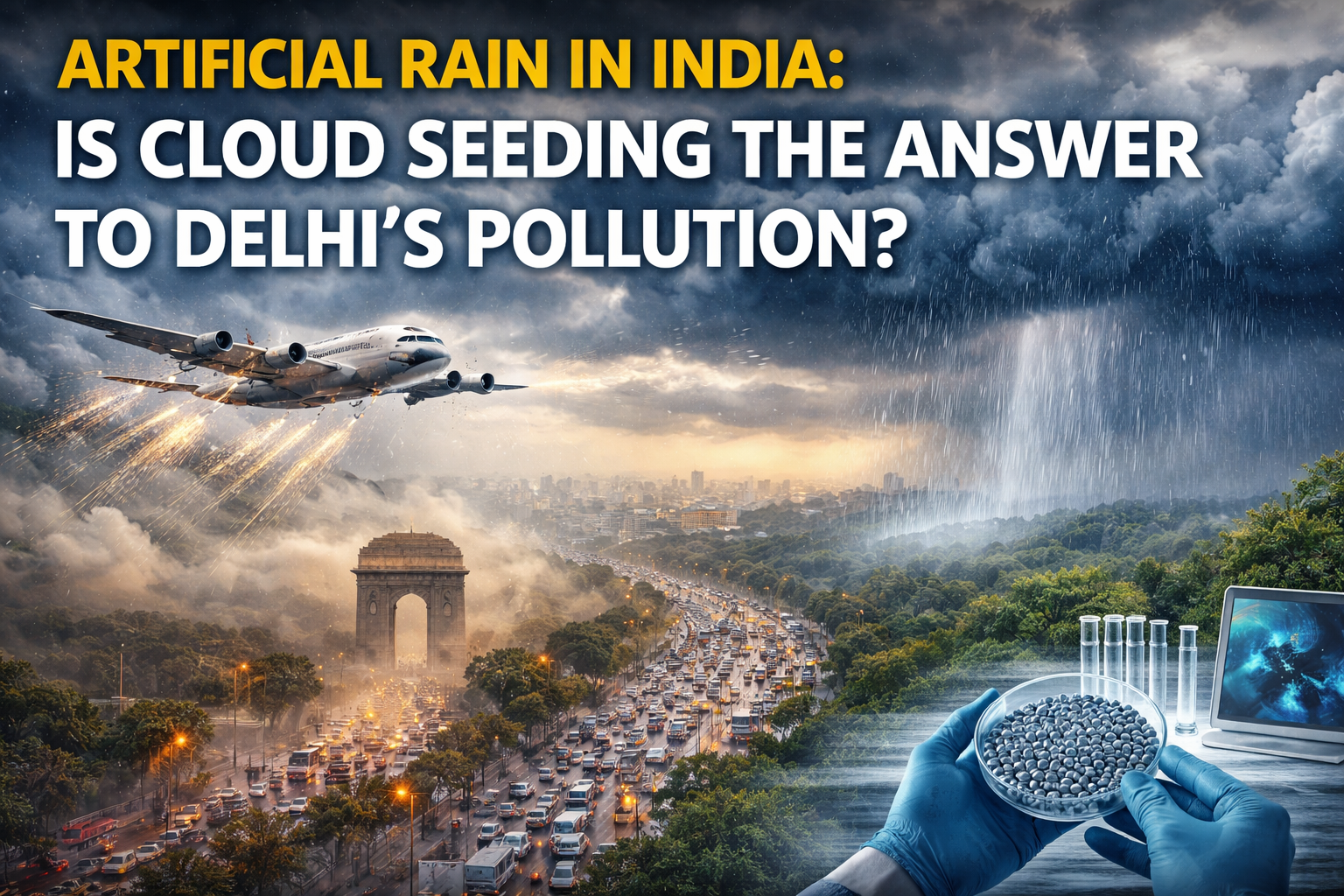
In October 2025, that tool was artificial rain. The Delhi government, working with the Indian Institute of Technology Kanpur, attempted cloud seeding over the city as a way to literally wash the pollution out of the sky. It made headlines. It sparked debate. And ultimately, it did not produce a single drop of measurable rain over Delhi itself. So what exactly is cloud seeding, why did it fail, and is artificial rain ever going to be the answer India needs?
What Is Cloud Seeding and How Does Artificial Rain Work?
Cloud seeding is a weather modification technique that has been around for nearly 80 years. The basic idea is simple: you introduce tiny particles into existing clouds to encourage the water droplets inside them to combine and grow heavy enough to fall as rain. These particles are called cloud condensation nuclei, and they give the water vapour something solid to cling to as it builds into raindrops.
The process sounds almost magical, but the science behind it is grounded in real atmospheric physics. Here is how it works step by step.
Identify suitable clouds
Scientists study the type, height, temperature, and moisture content of clouds over the target area. Not all clouds can be seeded. The cloud needs to have a moisture level of at least 50 to 60 percent and must contain enough water vapour to produce rain with a little extra help.
Choose the seeding agent
The most commonly used seeding agent is silver iodide, which has a crystal structure very similar to ice and works extremely well as a nucleus for water droplet formation. In Delhi's 2025 trial, a mixture of silver iodide, common salt, and rock salt was used. The choice of agent depends on the temperature of the cloud base and the type of precipitation desired.
Deliver the seeding agent
A specially equipped aircraft or drone flies into or below the target cloud and releases flares or sprays containing the seeding agent. In Delhi's case, IIT Kanpur used a Cessna 206H aircraft that took off from Kanpur and flew over northwest Delhi to release its payload over areas including Burari, Karol Bagh, and Mayur Vihar.
Water droplets form and grow
The seeding particles act as nuclei around which water vapour condenses. As more droplets gather on each particle, they grow heavier. When they become heavy enough to overcome the cloud's updrafts, they fall as rain, ideally washing away dust, particulate matter, and other pollutants from the air on their way down.
Measure the outcome
This is where things get complicated. Proving that rain was caused by cloud seeding and not by natural processes is extremely difficult. Even in successful experiments, separating the seeding effect from what would have happened anyway remains one of the biggest scientific challenges in weather modification research.
Why Delhi Turned to Artificial Rain for Pollution Control
Understanding why Delhi reached for cloud seeding in October 2025 requires understanding what Delhi's winter air pollution crisis actually looks like at ground level. Every year, as temperatures drop and winds slow, a weather phenomenon called temperature inversion traps pollutants close to the ground. Normally, warm air rises and carries pollutants upward, dispersing them. During inversion, a layer of warm air sits above cool air at the surface, acting like a lid on a pot and preventing any upward dispersal.
Into this trapped layer comes a toxic mix from multiple sources. Central Pollution Control Board (CPCB) data consistently shows that Delhi's winter pollution draws from vehicular exhaust, industrial emissions, construction dust, and the burning of crop stubble in neighboring states like Punjab and Haryana. Diwali firecracker smoke adds a sharp spike each year. The result is PM2.5 concentrations, tiny particles small enough to enter the bloodstream, that routinely exceed safe limits by five to ten times.
Rain is one of nature's most effective ways to clean the air. When it rains, water droplets absorb and carry down particulate matter, dust, and water-soluble pollutants from the atmosphere. The logic behind artificial rain is straightforward: if the sky will not rain naturally, make it rain artificially, and let the rain do the cleaning. The Delhi government approved Rs 3.2 crore for five cloud seeding trials between October and December 2025, partnering with IIT Kanpur under a formal memorandum of understanding.
This is a scientific leap of hope for Delhi. If conditions are favorable, it can bring artificial rain that improves air quality and provides immediate relief during the most polluted months.
Deepu Philip, IIT Kanpur, October 2025What Actually Happened: The October 28, 2025 Trial
The cloud seeding aircraft took off from IIT Kanpur on October 28, 2025, and conducted two runs over Delhi, the first at 12:15 PM and the second at 3:55 PM. The Cessna 206H released flares containing 20 percent silver iodide mixed with common salt and rock salt over targeted pollution hotspot areas in northwest Delhi. The operation was approved by 23 government departments including the Directorate General of Civil Aviation.
Environment Minister Manjinder Singh Sirsa called the trials technically successful. But the numbers told a different story. Despite the successful completion of trials, no measurable rainfall was recorded, and Delhi's air quality remained in the "poor" to "very poor" category the following morning.
The reason was atmospheric. Humidity levels of only 15 to 20 percent were reported in clouds, far below the 50 to 60 percent required for rainfall induction. Only trace amounts of 0.1 to 0.2 mm were reported in NCR regions like Noida and Greater Noida — areas the aircraft did not even target. The experiment, despite its ₹64 lakh per run cost, produced no rain over Delhi and no improvement in air quality.
What the Scientists and Experts Are Saying
The scientific community's response to Delhi's cloud seeding experiment was largely critical, not because the idea is entirely without merit, but because the conditions in Delhi during peak pollution season make it nearly unworkable. Experts from India's leading atmospheric research institutions were direct in their assessments.
| Expert / Institution | Key Statement |
|---|---|
| Sachin Ghude, IITM Pune | During winter, the probability of cloudy days over Delhi and NCR is generally less than 20%, while clouds suitable for seeding are even lower, at less than 3%. |
| Thara Prabhakaran, Cloud Seeding Expert, IITM | No systematic scientific studies have been conducted in Delhi on this aspect so far. Even if artificial rain occurs from the experiment, it only has temporary impacts and is not a long-term solution. |
| D. Raghunandan, Delhi Science Forum | Cloud seeding is not a permanent solution. The Delhi government is chasing silver bullet solutions. It works only when conditions are favorable, and Delhi's winter skies are usually very dry. |
| Professor Koll, Atmospheric Scientist | It works only when clouds with enough moisture are already present, and even then, its effect is small and short-lived. At best, it may bring a brief drizzle that washes out some dust and particles for a few hours. |
| IIT Kanpur Team | Called the October 28 trials "technically successful" despite no rainfall. Described cloud seeding as an SOS measure, not a permanent solution to pollution. |
Real Challenges: Why Cloud Seeding Is So Hard to Get Right
Even in countries where cloud seeding has been practiced for decades, like the United Arab Emirates, China, and the United States, the results are inconsistent and the science is still evolving. India's attempt in Delhi faces a particularly tough set of challenges.
Challenge 1: You Cannot Seed What Is Not There
The most fundamental limitation is also the simplest one. Cloud seeding requires clouds. Not just any clouds, but clouds with sufficient moisture, the right temperature profile, and the right atmospheric conditions. During periods of severe pollution, cloud cover is typically absent, further reducing the feasibility of cloud seeding as a mitigation option. This creates a cruel paradox: the days when Delhi's pollution is at its worst are precisely the days when cloud seeding is least feasible.
Challenge 2: Proving It Worked Is Almost Impossible
Even when cloud seeding does produce rain, isolating the effect of the seeding from what would have happened naturally is extremely difficult. This is why the scientific community has so much trouble building conclusive evidence for or against cloud seeding's effectiveness. According to the Indian government, the experiment helped to reduce air pollution — but researchers attribute that to the weather. When pollution improved slightly after the trials, officials credited cloud seeding. Scientists said a natural change in wind patterns was responsible.
Challenge 3: The Relief Is Brief
Even when artificial rain does fall, it cleans the air only temporarily. There is only a momentary improvement in air quality because of the pollution. The sources of pollution, vehicles, factories, stubble fires, construction sites, continue operating without pause. Within hours or days, pollution levels return to where they were before the rain. It is the atmospheric equivalent of mopping a floor while the tap is still running.
Challenge 4: Regulatory and Logistical Complexity
Delhi's cloud seeding trial required clearances from 23 government departments, including aviation authorities. The coordination between the Delhi government, IIT Kanpur, the Indian Meteorological Department, and the Indian Institute of Tropical Meteorology took months. By the time all approvals were in place and the aircraft was ready, the best window of atmospheric opportunity had often already passed.
Environmental Risks: Is Artificial Rain Safe?
Any discussion of cloud seeding must also address the environmental questions it raises. The chemicals used in seeding, particularly silver iodide, are introduced into the atmosphere and eventually fall to the ground with the rain. While studies suggest the concentrations involved are generally low, the long-term risks deserve serious attention.
- Soil and groundwater contamination: Environmental risks associated with the use of chemical agents can potentially contaminate soil and water bodies and impact biodiversity. Long-term exposure may also affect soil fertility and groundwater quality.
- Unintended precipitation redistribution: Rain produced over one area may reduce rainfall that would have fallen elsewhere. This raises ethical and legal concerns, particularly when neighboring states or countries depend on the same weather systems.
- Ecological disruption: Sudden rainfall in areas not prepared for it can cause flash flooding, disrupt local ecosystems, and damage crops or infrastructure, especially if the timing or intensity of the artificial rain is misjudged.
- Unknown long-term effects: Cloud seeding in urban environments at the scale being proposed for Delhi is largely unstudied. The cumulative effect of repeated chemical introductions into a metropolitan airshed is not well understood by science yet.
- False sense of security: Perhaps the most significant environmental risk is political. If cloud seeding is seen as a working solution, it reduces the urgency to address the actual sources of pollution. It becomes a reason to avoid hard decisions rather than make them.
Where Has Cloud Seeding Actually Worked?
It would be unfair to write off cloud seeding entirely. In the right conditions, it does work, and there are real-world examples that prove it.
| Country / Event | Purpose | Outcome |
|---|---|---|
| China, 2008 Beijing Olympics | Prevent rainfall during the opening ceremony | Rockets seeded clouds before they reached Beijing, keeping the ceremony dry. Largely considered a success. |
| United Arab Emirates | Increase rainfall in an arid climate | Regular cloud seeding operations have increased rainfall in specific regions. Ongoing program with measurable results over time. |
| USA (Western States) | Augment snowpack for water supply | Cloud seeding over mountain ranges has produced modest increases in snowpack, supporting water reservoirs. Effect is estimated at 5 to 15 percent increase. |
| India (Maharashtra) | Drought mitigation during weak monsoon | Mixed results. Some years show increased rainfall in target zones; other years show no measurable effect due to absence of suitable cloud cover. |
| Delhi, October 2025 | Air pollution reduction via artificial rain | No measurable rainfall. No improvement in AQI. Cloud moisture at 15 to 20 percent against required 50 to 60 percent minimum. |
The pattern is clear. Cloud seeding works best for drought mitigation in agricultural regions during the monsoon season, where clouds are present and moisture is abundant. It works poorly as an emergency pollution-control measure in winter cities where skies are dry and cloud cover is minimal.
The Bigger Question: Is This a Long-Term Solution or Just a Quick Fix?
This is the question that matters most, and the answer from the scientific community is nearly unanimous. Cloud seeding for pollution control in Delhi is, at best, an emergency SOS measure and, at worst, an expensive distraction from the structural reforms India actually needs. The only effective way forward lies in long-term strategies targeting emission reduction and source control, which directly address the root causes of Delhi's air quality crisis.
What It Can Do
- Provide brief temporary relief during a severe pollution spike if suitable clouds are present
- Wash some particulate matter and dust out of the air for a few hours
- Serve as a short-term emergency measure during extreme AQI events
- Generate scientific data on atmospheric conditions over Delhi
- Raise public awareness about the severity of Delhi's pollution crisis
What It Cannot Do
- Create clouds or moisture where none exist
- Reduce the sources of pollution — vehicles, factories, stubble burning
- Provide lasting improvement in air quality beyond a few hours
- Work reliably during Delhi's peak winter pollution months
- Replace structural policy reform and emission control strategies
What India Actually Needs: Real Solutions to Delhi's Air Crisis
If cloud seeding is not the answer, what is? Experts and research institutions consistently point to a set of proven, evidence-backed interventions that address the root causes of Delhi's air pollution rather than its symptoms.
- Stubble burning elimination through farmer support. A significant portion of Delhi's winter pollution spike comes from crop residue burning in Punjab and Haryana. Studies show that redirecting the ₹3.2 crore spent on cloud seeding toward providing farmers with machinery and economic incentives for residue management would have a far greater and longer-lasting impact on Delhi's air quality.
- Aggressive transition to electric vehicles. Vehicular emissions are one of the largest contributors to Delhi's PM2.5 levels year-round. Expanding EV charging infrastructure, offering stronger purchase incentives, and tightening emission standards for older vehicles would produce measurable improvements across all seasons.
- Industrial emission controls and source elimination. The closure of the Badarpur Thermal Power Station in 2018 demonstrated that removing pollution sources works. Similar controls applied to other industrial sectors operating in and around Delhi would reduce baseline pollution levels permanently.
- Real-time source-specific monitoring. India needs better data on exactly which sources are contributing what proportion of pollution at any given time. Satellite monitoring, ground sensor networks, and AI-driven source attribution can give policymakers the information they need to target the highest-impact interventions first.
- Regional coordination among states. Delhi's air does not respect administrative boundaries. Punjab, Haryana, Uttar Pradesh, and Rajasthan all contribute to the airshed. Effective pollution control requires coordinated action across state lines, which currently remains one of the biggest governance failures in Indian environmental policy.
- Urban green cover and dust control. Increasing tree cover in Delhi, managing construction site dust, and improving road surface quality can reduce the particulate baseline that climate and traffic then amplify during winter inversions.
India's Broader Cloud Seeding Ambitions
Delhi's October 2025 trial was not India's first experience with cloud seeding and will not be its last. Maharashtra has conducted cloud seeding operations during drought years to support agriculture in water-scarce regions. Karnataka and Andhra Pradesh have run similar programs. The Indian Meteorological Department has been involved in cloud seeding research since the 1950s.
Cloud seeding holds promise as a short-term response in three key areas. It can provide temporary relief during severe droughts by augmenting rainfall for agriculture and rural water security. It may serve as an emergency air-quality intervention during extreme pollution episodes. And it can support agricultural stabilisation in rain-fed areas during delayed or weak monsoons. These are legitimate use cases. The problem arises when cloud seeding is positioned as a solution to a problem it was never designed to solve — chronic, structurally driven urban air pollution.
The Ministry of Earth Sciences has expressed interest in expanding cloud seeding research, particularly for agricultural water security and pre-monsoon drought mitigation. These applications deserve continued scientific investment. But they must be separated clearly from the narrative that artificial rain can solve Delhi's pollution crisis, because it cannot.
Frequently Asked Questions
1 What is artificial rain and how is it created in India?
2. Did Delhi's cloud seeding experiment work in 2025?
3. Is cloud seeding harmful to the environment?
4. Why does Delhi have such severe air pollution every winter?
5. How much did Delhi's artificial rain project cost?
6. What are better long-term solutions to Delhi's air pollution than cloud seeding?
7. Has cloud seeding worked anywhere in the world for pollution control?
The Verdict: Hope Is Not a Pollution Policy
Delhi's air pollution crisis is real, urgent, and deeply damaging to the health of millions of people. The instinct to try something, anything, to address it is understandable and even admirable. Cloud seeding, as a scientific idea, is not without merit. In the right conditions, for the right purposes, it can deliver results. But those conditions do not exist over Delhi during winter. And those purposes do not include solving a problem built from decades of vehicular emissions, agricultural burning, and urban sprawl.
The Rs 3.2 crore spent on five cloud seeding trials produced no rain and no lasting improvement in air quality. That money, redirected toward farmer support programs for stubble management or EV charging infrastructure, might have made a difference that people could actually breathe. The lesson from October 28, 2025 is not that cloud seeding does not work. It is that fighting structural problems with atmospheric band-aids will always fall short.
India deserves a pollution policy built on what the evidence says, not on what makes the best headline. Until Delhi addresses its emission sources with the same ambition it applied to making it rain, its winters will remain what they have always been — a public health emergency wrapped in grey.
For more fact-driven coverage on India's environmental policies, automobile sector updates, and public finance topics that affect everyday life, keep reading BlogofTime.com — where every story is grounded in research, written in plain language, and built to actually help you understand the world around you.