Content options
Is World War III Really Coming? Here Is What You Need to Know
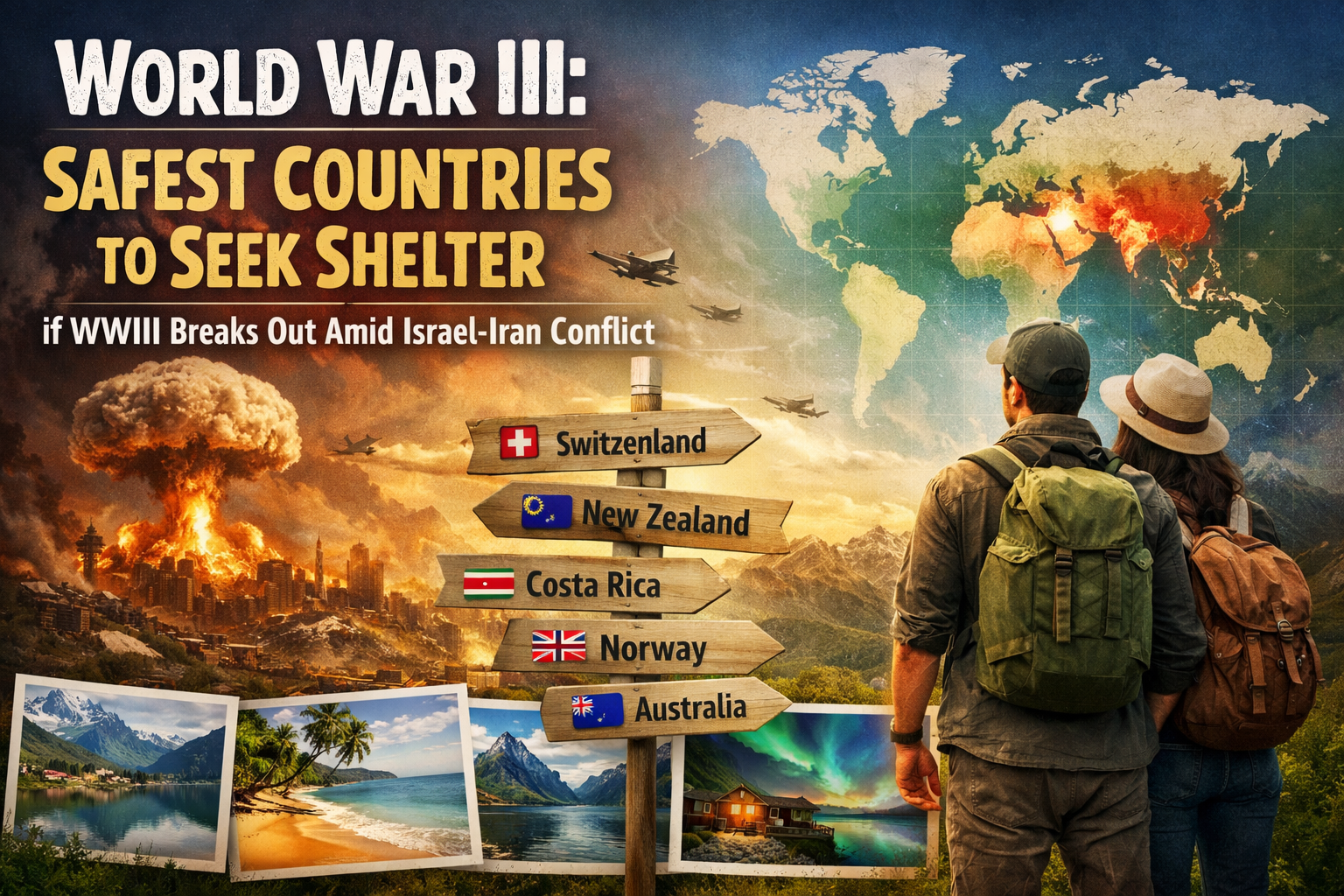
Tensions between Israel, Iran, and the United States have reached a boiling point. Iran launched a barrage of missiles and drones targeting Israel and nearby nations, including the United Arab Emirates, Qatar, and Bahrain. The US-Israel response followed quickly, and Tehran described it as a direct attack on its sovereignty. Global leaders are scrambling, and millions of people around the world are typing one question into search engines: Where is the safest place to be if World War III starts?
This is not just a theoretical question anymore. The Middle East conflict has the potential to pull in major world powers, and history tells us that wars rarely stay contained to one region. People are right to be concerned, and it is smart to be prepared.
In this guide, we break down the safest countries in the world if WWIII breaks out, why they make the list, and what survival experts and geopolitical analysts say about each one.
Global Peace Index 2024: Top Safe Countries at a Glance
The Global Peace Index (GPI), published annually by the Institute for Economics and Peace, ranks 163 nations based on factors like military conflict, political instability, violent crime, and international relations. Here is how the top safe zones stack up:
|
Rank |
Country |
GPI Score (2024) |
Key Safety Factor |
|
1 |
Iceland |
1.112 |
No military, remote island, top GPI rank |
|
2 |
Ireland |
1.304 |
Neutral stance, EU member, stable |
|
3 |
Austria |
1.313 |
Neutrality treaty, central Europe |
|
4 |
New Zealand |
1.337 |
Remote Southern Hemisphere, self-sufficient |
|
5 |
Singapore |
1.347 |
Stable governance, low conflict risk |
|
6 |
Switzerland |
1.339 |
Political neutrality, underground shelters |
|
7 |
Portugal |
1.368 |
Peaceful, NATO but low conflict profile |
|
8 |
Bhutan |
1.456 |
Landlocked, mountainous, neutral since 1971 |
|
9 |
Fiji |
1.520 |
Remote Pacific island, dense forests |
|
10 |
Chile |
1.551 |
Natural borders, resource-rich, non-aligned |
Source: Institute for Economics and Peace, Global Peace Index 2024
The Full List: Safest Countries to Survive World War III
1. Iceland: The World's Most Peaceful Nation
Iceland sits at the very top of the Global Peace Index and has held that position for years. This small Nordic island nation has no standing army, no history of involvement in modern warfare, and sits in the remote North Atlantic Ocean far from the main theaters of any potential global conflict.
The country's harsh volcanic terrain and sparse population of just 370,000 people make it an unattractive military target. Iceland has never been invaded in the modern era, and its geographic isolation means that even a global conflict would likely leave it untouched. If you are looking for the single safest country in the world if WWIII breaks out, Iceland is the top answer according to peace researchers worldwide.
Why Iceland is safe: No army, top Global Peace Index ranking, remote location, low population, not a strategic military target.
2. New Zealand: The Southern Hemisphere's Best Shelter
New Zealand ranks second on the Global Peace Index and is widely considered one of the best survival destinations if a world war erupts. Located thousands of miles away from major conflict zones in the Southern Hemisphere, New Zealand benefits from natural isolation that very few countries can match.
The country has rich agricultural land, clean freshwater reserves, and mountainous terrain that provides natural defense. New Zealand has historically taken a neutral stance on many international disputes and is not aligned with aggressive military blocs. Even in a nuclear scenario, scientists suggest the Southern Hemisphere would receive significantly less fallout than the Northern Hemisphere.
Why New Zealand is safe: Remote location, high GPI rank, self-sufficient food production, neutral foreign policy, minimal nuclear fallout risk.
3. Switzerland: The King of Neutrality in Europe
Switzerland has been politically neutral for over 500 years. Even during World War Two, when all of Europe was burning, Switzerland remained untouched. This tiny landlocked country surrounded by the Alps has built its entire identity around staying out of other people's wars, and it has succeeded brilliantly.
Switzerland has an extensive network of underground nuclear shelters that can house its entire population of 8.7 million people. The Swiss government has invested heavily in civil defense infrastructure for decades. Switzerland is also notably absent from NATO and has not provided military assistance to either side in the Ukraine conflict, reinforcing its neutral image on the world stage.
Why Switzerland is safe: 500 years of neutrality, underground shelters for all citizens, Alpine terrain, non-NATO, strong civil defense system.
4. Bhutan: The Himalayan Kingdom That Chose Peace
In 1971, Bhutan formally declared neutrality upon joining the United Nations and has kept that promise ever since. Nestled deep in the Himalayas between India and China, Bhutan is naturally protected by some of the world's most impenetrable mountain ranges. Its landlocked geography means there is no easy route in for any invading force.
Bhutan measures national success through Gross National Happiness rather than GDP, which reflects a society deeply focused on well-being over conflict. The country has minimal international military footprint, no nuclear ambitions, and stays away from the geopolitical games of its giant neighbors.
Why Bhutan is safe: Himalayan mountain protection, declared neutral since 1971, no military alliances, isolated geography, peaceful society.
5. Fiji: A Pacific Island Paradise With a Safety Edge
Fiji is a remote island nation in the South Pacific, sitting roughly halfway between Australia and Hawaii. This distance from major global powers makes it an extremely unlikely target in any world conflict. Fiji ranks highly on the Global Peace Index and has dense tropical forests that could support survival in extreme scenarios.
The country's small military of around 6,000 soldiers is largely used for UN peacekeeping missions rather than offensive operations. Fiji is self-sustaining in terms of food, water, and basic agriculture, which means it could continue functioning even if global supply chains collapsed.
Why Fiji is safe: Remote South Pacific location, high GPI rank, self-sustaining resources, dense forests, no military alliances.
6. Indonesia: Southeast Asia's Neutral Giant
Indonesia follows what its founding president Sukarno called a 'free and active' foreign policy, meaning the country acts independently in international affairs without aligning with major military powers. With over 17,000 islands spread across a vast archipelago, Indonesia is one of the hardest countries in the world to occupy or target comprehensively.
The country is not part of any major military bloc and has a consistent track record of non-alignment. Indonesia's sheer geographic size disperses any potential military risk across an enormous area, making it one of the safer large nations if global conflict erupts.
Why Indonesia is safe: Free and active neutrality policy, 17,000 islands make targeting difficult, not part of military blocs, large population and resources.
7. Chile: Natural Borders and Resource Independence
Chile is one of the most naturally isolated countries on Earth. To the east, the Andes Mountains create a nearly impassable barrier. To the west, the Pacific Ocean stretches for thousands of miles. To the north lies the Atacama Desert, one of the driest places on the planet, and to the south is Patagonia's wild, frozen terrain.
This natural fortress makes Chile geographically difficult to reach and attack. The country is rich in natural resources including copper, lithium, fresh water, and fertile farmland that could sustain its population even if global trade broke down. Chile is not aligned with major military blocs, which lowers its profile as a conflict target.
Why Chile is safe: Natural borders on all sides, resource independence, non-aligned foreign policy, self-sufficient agriculture, isolated from conflict zones.
8. Tuvalu: The Tiny Pacific Nation Off Every Target List
Tuvalu is one of the smallest and most remote nations on Earth, with a population of just 11,000 people scattered across a handful of Pacific atolls. This tiny size and extreme remoteness is actually a powerful safety advantage in a world war scenario. Tuvalu has virtually no strategic resources, no military infrastructure, and no political significance that would make it a target.
The country sits roughly halfway between Hawaii and Australia, far from any major conflict theater. While Tuvalu faces serious climate challenges with rising sea levels, in a WWIII scenario it would likely be left completely alone by any warring parties.
Why Tuvalu is safe: Extremely remote location, no strategic value, tiny population, no military presence, completely off the target radar.
9. South Africa: Resource-Rich Survival Hub
South Africa benefits from having some of the most diverse and abundant natural resources on the African continent. The country produces its own food, has significant freshwater sources, and maintains modern infrastructure that could support a large population during a global crisis.
Located at the southern tip of Africa, South Africa is far from the main zones of conflict in Europe, the Middle East, and Asia. While the country has its own internal challenges, its resource self-sufficiency and geographic distance from likely conflict zones make it a reasonable survival option in a WWIII scenario.
Why South Africa is safe: Resource self-sufficiency, fertile land, freshwater supply, modern infrastructure, geographic distance from conflict zones.
10. Greenland: Arctic Isolation as a Shield
Greenland is the world's largest island and one of its most sparsely populated places, with fewer than 57,000 residents spread across 2.1 million square kilometers of ice and rock. This extreme isolation and minimal population means Greenland has almost no strategic military value to any power in a conventional sense.
The harsh Arctic climate and remote location make it a deeply unattractive target, and limited infrastructure means there is little worth attacking. Greenland maintains low international friction and political neutrality that keeps it out of global rivalries, making it one of the more unconventional but genuinely safe options on this list.
Why Greenland is safe: Extreme Arctic remoteness, minimal population, no strategic targets, low political friction, natural isolation.
What Makes a Country Safe During World War III?
Not every peaceful country will stay safe in a global war. Here are the key factors survival experts and geopolitical analysts look for when identifying true safe zones:
- Geographic isolation: Countries far from Europe, the Middle East, and East Asia are at lower risk of direct conflict spillover.
- Political neutrality: Nations that do not belong to aggressive military alliances are less likely to become targets.
- Food and water self-sufficiency: A country that can feed itself does not depend on global supply chains that would collapse in wartime.
- Low strategic military value: Countries with no major oil reserves, nuclear facilities, or critical military infrastructure are unattractive targets.
- Natural geographic barriers: Mountains, oceans, deserts, and dense forests all provide natural defense and protection.
- Strong civil defense infrastructure: Some countries like Switzerland have actual shelters and emergency plans for their entire population.
- Nuclear fallout distance: The Southern Hemisphere generally receives far less nuclear fallout from a Northern Hemisphere conflict due to atmospheric patterns.
Countries to Avoid if WWIII Starts
Knowing where not to be is just as important as knowing where to go. These are the regions that analysts consider highest risk:
|
High-Risk Region |
Reason for Risk |
|
Middle East (Israel, Iran, Syria) |
Active conflict zone, multiple warring factions, nuclear threats |
|
Eastern Europe (Ukraine, Poland borders) |
Active Russia-Ukraine war spillover risk |
|
Taiwan Strait / South China Sea |
US-China flashpoint, potential military confrontation |
|
Korean Peninsula |
North Korea nuclear threat, military standoff |
|
Major NATO capitals (US, UK, France) |
Primary targets in any nuclear exchange scenario |
Practical Tips for Preparing Right Now
Whether you choose to stay or relocate, preparation is key. Here are steps you can take today:
- Build a 30-day emergency food and water supply at home.
- Learn basic first aid and survival skills before any crisis hits.
- Research dual citizenship or residency options in safe countries.
- Keep important documents like passports, birth certificates, and financial records backed up digitally and physically.
- Monitor updates from trusted sources like the United Nations, BBC World News, and your national government emergency services.
- Identify your nearest civil defense shelter if you live in a high-risk region.
Frequently Asked Questions (FAQ)
Q: Has World War III started in 2024?
As of mid-2024, World War III has not officially started, but tensions between Israel, Iran, the United States, and Russia have escalated to levels not seen since the Cold War. Multiple military exchanges have taken place in the Middle East, and experts warn that further escalation could spiral into a broader global conflict.
Q: Which country is the safest in a nuclear war?
Iceland, New Zealand, and Bhutan are consistently named as among the safest countries in a nuclear war scenario. Their remote locations, distance from likely target zones, and minimal strategic military value reduce nuclear risk significantly. Switzerland is also notable for having enough underground nuclear shelters to house its entire population.
Q: Why is New Zealand considered a top safe haven for WWIII?
New Zealand sits in the Southern Hemisphere, thousands of miles from the major conflict zones in Europe, the Middle East, and Asia. Scientists suggest the Southern Hemisphere receives significantly less nuclear fallout in a Northern Hemisphere conflict due to atmospheric circulation patterns. New Zealand is also food self-sufficient and politically neutral on most major disputes.
Q: Is Switzerland truly neutral in World War III?
Switzerland has maintained official neutrality for over 500 years and is not a NATO member. It has not provided military assistance to either side in the Ukraine conflict, reinforcing its neutral status. Switzerland also has one of the world's most comprehensive civil defense systems, with underground shelters capable of housing all 8.7 million of its citizens.
Q: What makes Bhutan safe during a world war?
Bhutan declared official neutrality in 1971 upon joining the United Nations. It is surrounded by the Himalayan mountains on all sides, making it one of the most naturally protected nations on Earth. Bhutan has no military alliances, no nuclear ambitions, and is not involved in the geopolitical rivalries of its neighbors India and China.
Q: Can you actually relocate to a safe country before WWIII?
Yes, many people are already exploring options for second residency or citizenship in safer countries. New Zealand, Portugal, Switzerland, and several Pacific Island nations offer various visa and residency pathways. However, it is important to plan early, as borders can close quickly once a major conflict begins.
Q: What is the Global Peace Index and how does it rank safety?
The Global Peace Index is published annually by the Institute for Economics and Peace and ranks 163 countries based on factors including ongoing conflict, societal safety, and militarization. A lower score indicates greater peace. Iceland has topped the index for 15 consecutive years as of 2024.
Final Thoughts: Be Informed, Be Prepared
The world is at a critical crossroads. The Israel-Iran conflict, combined with ongoing tensions in Ukraine and the Taiwan Strait, has created a geopolitical climate that many analysts describe as the most dangerous since the Cold War. Nobody wants a World War III, but the smart move is always to be informed and prepared rather than caught off guard.
The countries on this list offer genuine safety advantages based on geographic isolation, political neutrality, resource self-sufficiency, and their absence from the strategic calculations of major military powers. Whether you are researching as a concerned citizen or actively planning for the worst, knowledge is your most powerful tool.
Stay updated on global developments, build your emergency preparedness kit, and research your options for safe relocation if the situation worsens. The key is to act before a crisis forces your hand.
For more in-depth guides on global news, safety preparedness, geopolitical analysis, and survival planning, visit Blogoftime, where we bring you expert content to help you stay informed, stay safe, and stay ahead of the world's most important stories.