Content options
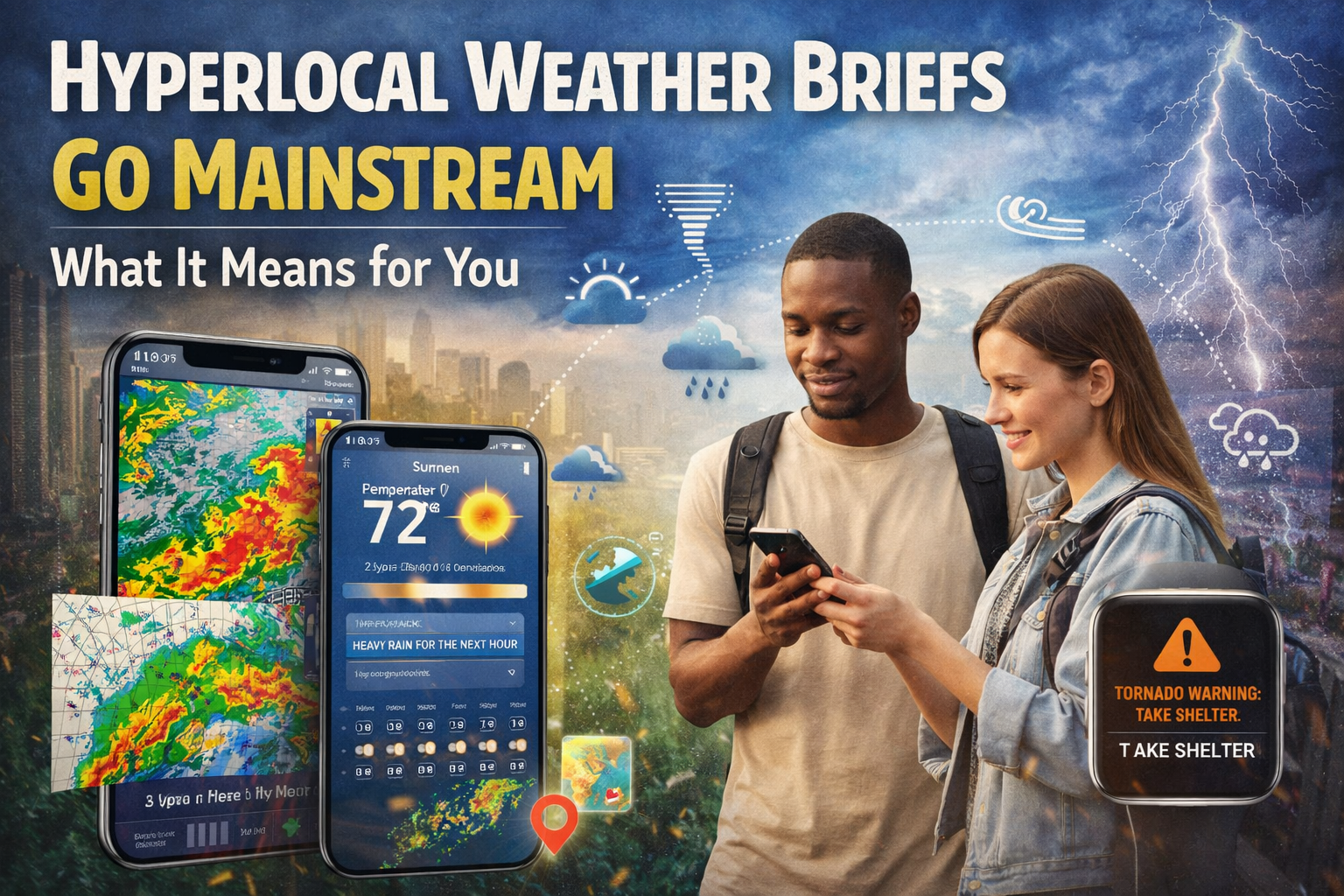
The days of one-size-fits-all weather forecasts are over. In 2026, hyperlocal weather briefs — ultra-precise, neighborhood-level forecasts — have moved from a niche novelty to a mainstream everyday tool. Powered by AI weather prediction, dense sensor networks, and real-time satellite imagery, these hyper-targeted updates are changing the way millions of people plan their commutes, workouts, events, and even their moods.
What Are Hyperlocal Weather Briefs?
Unlike traditional forecasts that cover an entire city or region, hyperlocal weather forecasts provide conditions specific to a street, block, or even building. Two neighborhoods just three kilometers apart can experience dramatically different rain, temperature, and wind conditions — and hyperlocal weather apps are now sophisticated enough to capture and communicate those differences in real time.
Leading platforms are now delivering real-time weather updates as short, digestible briefs — think personalized push notifications that say "Rain arriving at your exact location in 12 minutes" rather than a generic city-wide forecast for the afternoon.
The Technology Behind the Trend
The rise of hyperlocal weather data is being driven by three major technological advances: dense IoT sensor grids installed across urban environments, next-generation AI weather prediction models trained on terabytes of granular meteorological data, and improved radar and satellite imagery with sub-kilometer resolution. Together, these systems can model microclimates with unprecedented accuracy, making truly precise neighborhood weather alerts possible for the first time.
Why Hyperlocal Weather Is Going Mainstream in 2026
The mainstream adoption of hyperlocal weather technology has been accelerated by three converging forces: consumer demand for weather personalization, the explosion of smart devices, and the increasing frequency of extreme weather events tied to climate change. People no longer accept being caught off guard by sudden storms or heat spikes. They expect their smart weather apps to anticipate conditions at their exact location, not the nearest airport weather station.
Major players including Google Weather, Apple Weather, and emerging platforms powered by weather API technology are integrating hyperlocal layers into their products, bringing precision forecasting to billions of smartphone users globally.
Impact on Industries and Daily Life
The applications of hyperlocal weather briefs extend far beyond personal convenience. Agriculture, logistics, construction, outdoor events, and insurance sectors are leveraging hyperlocal weather data to make smarter, more timely operational decisions. A construction foreman can now receive a 15-minute precipitation warning specific to their job site. A food delivery platform can reroute drivers based on real-time road conditions tied to block-level rain data.
The Role of AI in Personalizing Weather
Artificial intelligence is the engine powering this revolution. Modern AI weather prediction systems analyze historical patterns, live sensor feeds, satellite data, and even social signals to generate and continuously update real-time weather updates. Machine learning models are also learning user behavior — understanding that a runner needs a 90-minute window of dry conditions versus a commuter who just needs to know if they need an umbrella for a 10-minute walk.
Privacy and Data Considerations
With weather personalization comes increased reliance on precise location data. As hyperlocal weather apps become more embedded in daily life, questions about how user location data is stored, shared, and monetized are gaining prominence. Leading apps are now adopting on-device processing to deliver neighborhood weather alerts without continuously transmitting exact coordinates to third-party servers.
The Future of Hyperlocal Weather
As sensor density increases and AI weather models become more sophisticated, the accuracy and availability of hyperlocal weather forecasts will continue to improve. The next frontier includes real-time air quality briefs, UV index alerts, and allergy forecasts — all delivered at the neighborhood level. In 2026, hyperlocal weather technology is not just a feature; it is becoming a fundamental expectation of digital life.
Frequently Asked Questions
Q1. What is a hyperlocal weather forecast?
A hyperlocal weather forecast is a precise, real-time weather prediction for a very specific geographic area — such as a neighborhood, block, or single location — rather than a broad city or regional forecast.
Q2. Which apps provide the best hyperlocal weather updates?
Leading hyperlocal weather apps in 2026 include Tomorrow.io, Clime, Dark Sky (integrated into Apple Weather), Google Weather, and AccuWeather's MinuteCast feature, all of which offer real-time weather updates at street-level precision.
Q3. How does AI improve weather forecasting accuracy?
AI improves weather personalization and accuracy by processing vast datasets from satellites, IoT sensors, and historical climate records to generate and continuously refine real-time weather updates far faster than traditional numerical weather prediction models.
Q4. Are hyperlocal weather services free to use?
Most hyperlocal weather apps offer free basic tiers with limited update frequency and precision. Premium tiers with minute-by-minute neighborhood weather alerts and API access are typically available through subscription plans.
Q5. Can hyperlocal weather data be used by businesses?
Yes. Hyperlocal weather data is widely used by businesses in agriculture, logistics, retail, insurance, construction, and events management to optimize operations and reduce weather-related risks.