Content options
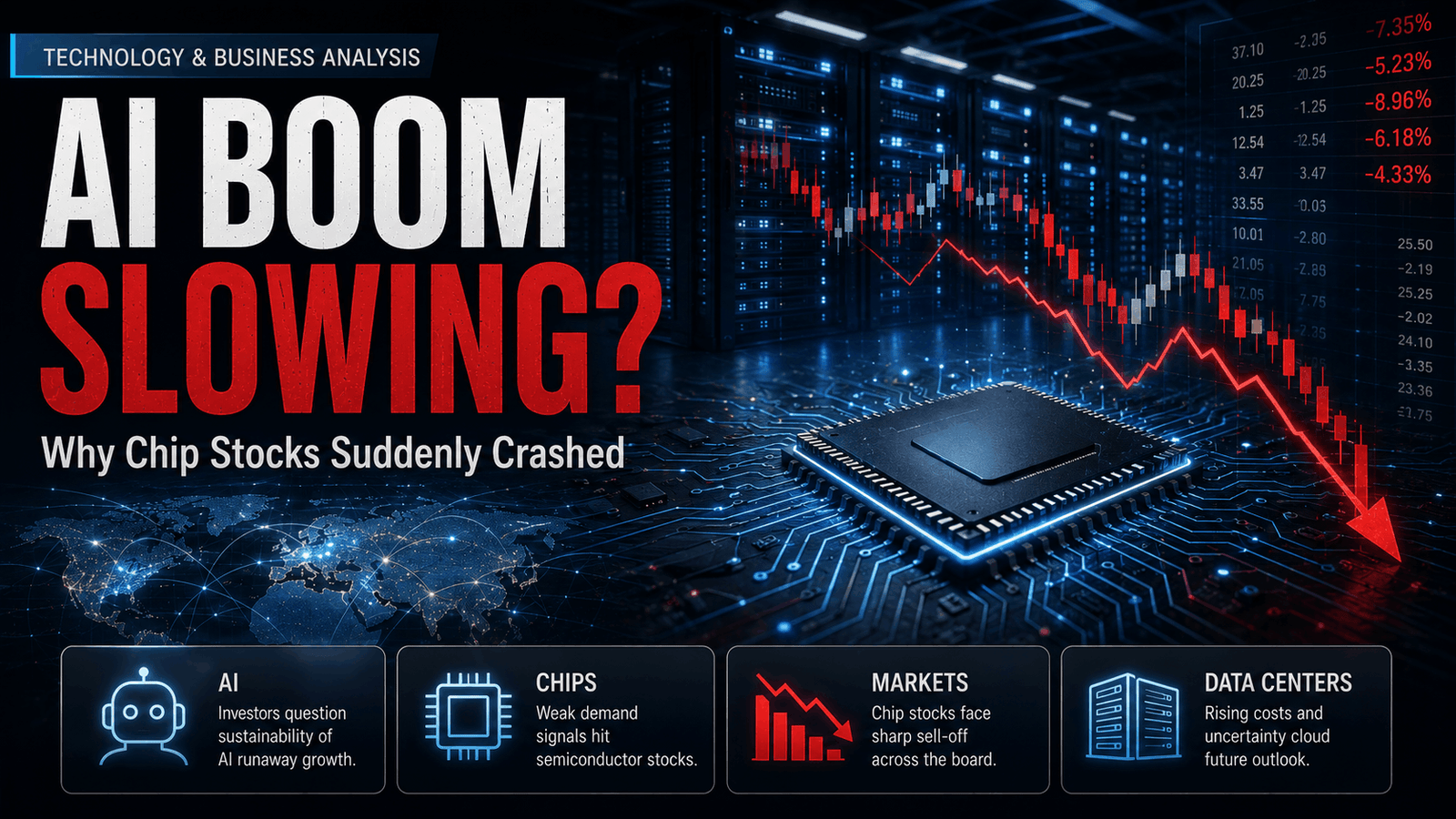
Is the AI Boom Slowing Down? Why Chip Stocks Suddenly Crashed (And Why AI Isn't Going Away)
Introduction
Over the past two years, artificial intelligence has transformed from a promising technology into one of the biggest investment stories in modern history.
Companies building AI chips, cloud infrastructure, and massive data centers saw their market values surge as businesses rushed to invest in the next generation of computing.
However, in recent weeks, investors have witnessed a sharp decline in several semiconductor stocks, raising a question that is now dominating financial markets:
Has the AI boom started to slow down?
The short answer is not necessarily.
The recent sell-off appears to reflect changing investor expectations rather than evidence that artificial intelligence itself is losing momentum. Understanding the difference is essential for anyone following technology, investing, or the future of business.
Why Did Chip Stocks Fall?
Semiconductor companies experienced extraordinary growth as demand for AI hardware accelerated.
Investors poured billions of dollars into companies producing:
- AI processors
- Graphics chips (GPUs)
- Memory chips
- Networking equipment
- Data center hardware
After months of rapid gains, many analysts believe the market entered a period of profit-taking, where investors lock in gains after a strong rally.
At the same time, expectations surrounding AI became extremely high.
Today, investors are no longer asking whether AI will grow.
Instead, they are asking:
Can AI companies continue growing fast enough to justify their current valuations?
That change in expectations has contributed to increased volatility across AI-related stocks.
The Difference Between an AI Slowdown and a Stock Market Correction
One of the biggest misconceptions is assuming that falling stock prices automatically mean an industry is failing.
In reality, markets often move ahead of business fundamentals.
A company's stock price may decline even while:
- Revenue continues growing.
- Customer demand remains strong.
- New products continue launching.
- Long-term opportunities remain attractive.
Stock markets reflect future expectations—not just current performance.
This distinction is particularly important in the AI industry, where expectations have risen dramatically over the past two years.
AI Demand Is Still Growing
Despite recent market volatility, demand for artificial intelligence infrastructure remains significant.
Technology companies continue investing billions of dollars in:
- AI data centers
- Cloud computing
- Advanced semiconductors
- Enterprise AI software
- Machine learning infrastructure
Organizations across healthcare, finance, manufacturing, education, retail, and logistics continue expanding AI adoption to improve productivity and automate complex tasks.
Rather than disappearing, AI investment is becoming more selective and increasingly focused on projects that deliver measurable business value.
Why Nvidia Remains at the Center of the AI Revolution
When people discuss AI hardware, one company usually dominates the conversation: Nvidia.
Its graphics processors have become the foundation of modern AI training and inference systems.
Large technology companies—including cloud providers and AI developers—continue purchasing high-performance chips to support increasingly powerful AI models.
However, with enormous success comes enormous expectations.
Even strong earnings may disappoint investors if they expect even faster growth.
This is one reason why leading AI stocks can experience sharp price movements despite healthy underlying businesses.
Data Centers: The Real Engine Behind AI
Artificial intelligence does not run only on software.
Every AI model depends on an enormous amount of physical infrastructure.
That includes:
- High-performance chips
- Advanced networking
- Massive cloud servers
- Electricity
- Cooling systems
- Modern data centers
As AI models become larger, demand for this infrastructure continues increasing.
This is one reason why countries—including India—are investing heavily in new data center projects.
The AI economy extends far beyond chatbots.
It includes an entire ecosystem of hardware, energy, cloud computing, and digital infrastructure.
Is This an AI Bubble or a Healthy Market Correction?
Whenever a fast-growing industry experiences a sudden decline, the word "bubble" quickly enters the conversation.
We saw this during the dot-com era, cryptocurrency cycles, and now, artificial intelligence.
But today's AI market is fundamentally different.
Unlike previous technology hype cycles, AI is already generating real business value across industries. Companies are using AI to:
- Automate customer support
- Improve software development
- Accelerate scientific research
- Optimize manufacturing
- Detect fraud in banking
- Enhance healthcare diagnostics
The debate is no longer whether AI works—it's about which companies will create sustainable long-term value.
That distinction makes the current market correction very different from the collapse of speculative technology bubbles.
Why This Matters for India
While investors focus on Wall Street, India has a unique opportunity.
As global demand for AI infrastructure grows, India is investing in:
- Semiconductor manufacturing
- Data center expansion
- Cloud infrastructure
- AI startups
- Digital public infrastructure
- Advanced electronics manufacturing
Government initiatives and private investment are helping position India as an emerging AI and technology hub.
If AI adoption continues expanding globally, Indian companies involved in chips, cloud computing, enterprise software, and digital infrastructure could benefit over the coming decade.
What Should Investors and Businesses Watch Next?
Instead of focusing only on daily stock movements, experts are watching several long-term indicators:
🖥️ AI Infrastructure Spending
Are cloud providers and enterprises continuing to invest in AI hardware?
⚡ Data Center Expansion
Can the world build enough computing capacity to support growing AI demand?
🔋 Energy Availability
AI requires enormous amounts of electricity. Future growth will depend partly on power infrastructure.
💼 Enterprise AI Adoption
How quickly are businesses turning AI experiments into real productivity gains?
🌍 Government Policies
Countries worldwide are introducing AI strategies, semiconductor incentives, and digital infrastructure investments that could shape future growth.
What Happens Next?
Several scenarios are possible.
Scenario 1 — Healthy Correction
Stock prices stabilize while AI adoption continues growing steadily.
Scenario 2 — Slower Investment Cycle
Companies become more selective with AI spending, focusing on projects that deliver measurable returns.
Scenario 3 — Next Wave of AI Innovation
New breakthroughs in robotics, AI agents, scientific research, and enterprise automation create another phase of growth.
At this stage, many analysts view the recent volatility as a reassessment of expectations rather than evidence that AI innovation has stopped.
Blog of Time Insight
History shows that every major technological revolution experiences periods of excitement followed by moments of doubt.
The internet, smartphones, cloud computing, and electric vehicles all experienced significant market corrections before becoming part of everyday life.
Artificial intelligence appears to be following a similar path.
The question is no longer whether AI will transform industries.
The real question is:
Which companies, countries, and professionals will adapt fastest to an AI-driven economy?
For long-term observers, today's market volatility may prove to be just one chapter in a much larger technological transformation.
Key Takeaways
✔ Falling chip stocks do not automatically mean the AI revolution is ending.
✔ Much of the recent decline reflects changing investor expectations after a period of exceptional market gains.
✔ Demand for AI infrastructure, cloud computing, and advanced semiconductors remains strong.
✔ India has an opportunity to strengthen its position through semiconductor manufacturing, data centers, and AI innovation.
✔ The long-term success of AI will depend on real-world adoption, infrastructure investment, and sustainable business value—not short-term stock market movements.
Conclusion
The recent decline in AI-related chip stocks has sparked headlines suggesting that the artificial intelligence boom may be fading.
However, market corrections and technological progress are not the same thing.
Stock prices often fluctuate as investors reassess valuations, but the underlying drivers of AI—including enterprise adoption, infrastructure investment, and scientific innovation—continue to move forward.
Rather than asking whether AI is ending, a more useful question may be:
How will the next phase of AI reshape businesses, economies, and everyday life?
That answer is likely to unfold over the coming years—not over the next few weeks of market volatility.
Frequently Asked Questions (FAQs)
1. Why did AI chip stocks fall?
Several factors contributed, including profit-taking after strong gains, high investor expectations, valuation concerns, and broader market sentiment.
2. Does this mean AI demand is declining?
Not necessarily. Many companies continue investing heavily in AI infrastructure, cloud computing, and enterprise AI solutions.
3. Why are semiconductor companies important for AI?
AI systems rely on high-performance chips, memory, networking hardware, and data centers to train and run advanced models.
4. Could India benefit from the AI boom?
Yes. India's investments in semiconductors, data centers, digital infrastructure, and AI startups could create long-term opportunities if global AI adoption continues to grow.
5. Is this a good time to panic about AI?
Technology markets often experience periods of volatility. Long-term trends depend on innovation, business adoption, and economic fundamentals rather than short-term stock movements.