Content options
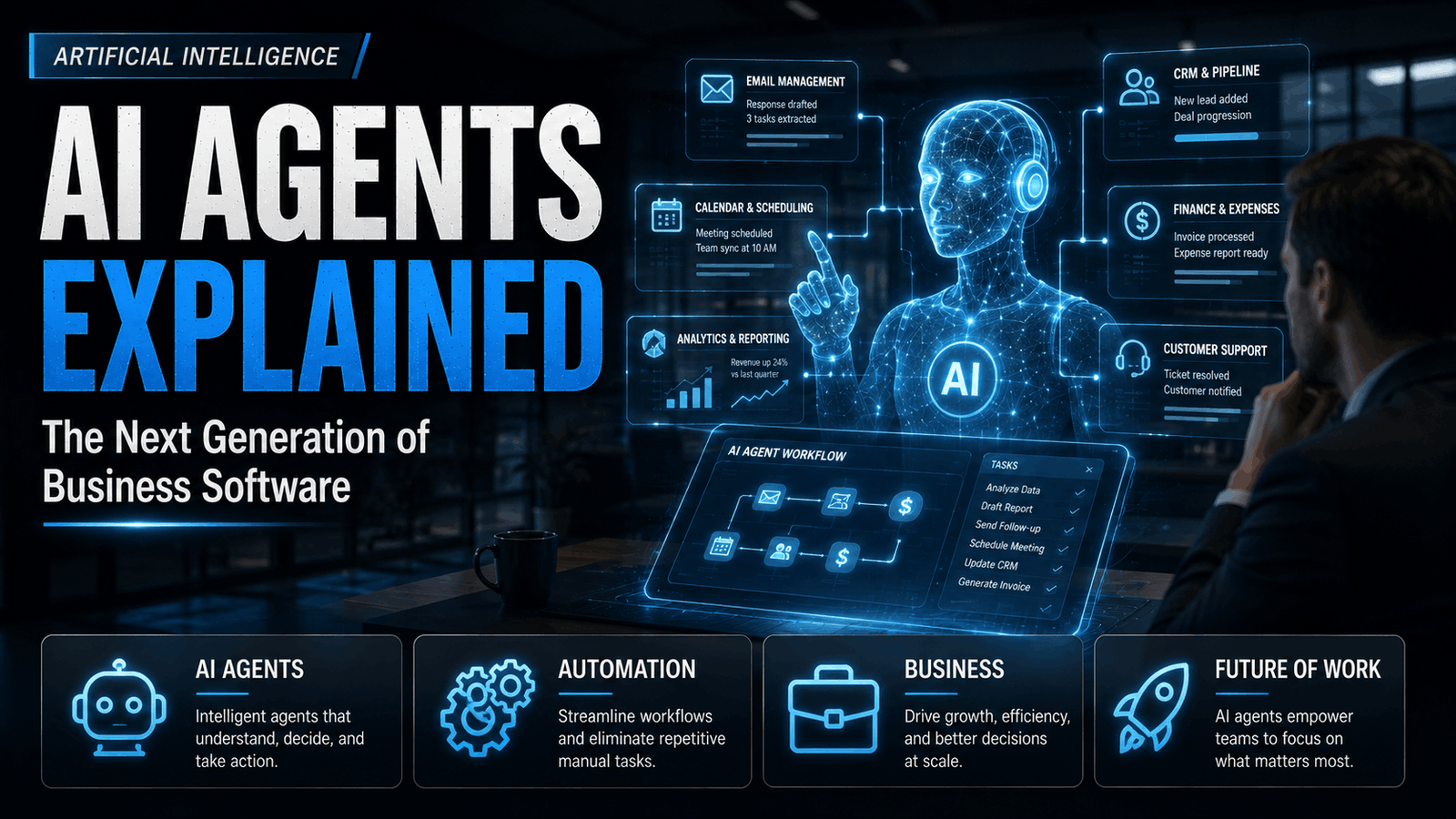
AI Agents Explained: Why They're Replacing Traditional Software (And Why Every Business Should Pay Attention)
Introduction
For decades, software has worked the same way.
A user opens an application, clicks buttons, enters information, and the software performs exactly the tasks it was programmed to do.
Artificial intelligence is changing that model.
Instead of waiting for instructions, a new generation of intelligent systems—known as AI agents—can understand goals, make decisions, plan actions, use digital tools, and complete complex tasks with minimal human supervision.
Many technology leaders believe AI agents could become one of the biggest shifts in computing since the rise of smartphones and cloud computing.
But what exactly are AI agents, and why are businesses investing so heavily in them?
What Is an AI Agent?
An AI agent is an intelligent software system designed to perform tasks on behalf of a user.
Unlike traditional software that follows fixed rules, AI agents can:
- Understand natural language.
- Break complex goals into smaller tasks.
- Make decisions.
- Learn from context.
- Interact with multiple applications.
- Complete workflows automatically.
Instead of simply answering questions, AI agents are designed to take action.
Traditional Software vs AI Agents
Think about booking a business trip.
Traditional Software
You would typically:
- Search for flights.
- Compare hotels.
- Book transportation.
- Update your calendar.
- Send confirmation emails.
Each step requires manual work across multiple applications.
AI Agent
An AI agent could:
- Understand your travel request.
- Search available flights.
- Compare prices.
- Recommend the best option.
- Book tickets after approval.
- Reserve a hotel.
- Update your calendar.
- Send confirmation emails.
The difference is simple:
Traditional software helps you perform tasks.
AI agents complete tasks for you.
Why Are AI Agents Different?
AI agents combine several capabilities into one intelligent system.
They can:
🧠 Reason
📋 Plan
⚡ Execute
🔄 Adapt
📊 Analyze
Instead of responding to a single prompt, they can manage entire workflows.
Why Every Major Tech Company Is Investing in AI Agents
The world's largest technology companies are rapidly developing AI agent technologies because they see them as the next evolution of artificial intelligence.
Current areas of investment include:
- Enterprise productivity
- Customer support
- Software development
- Healthcare
- Scientific research
- Finance
- Sales automation
- Supply chain management
The goal is not simply to answer questions but to automate increasingly complex business processes.
How Businesses Could Use AI Agents
Imagine a marketing company.
Instead of manually creating reports, scheduling campaigns, responding to emails, and analyzing customer data separately, an AI agent could coordinate many of these tasks together while employees focus on higher-value work.
Other examples include:
Finance
Preparing financial summaries.
Detecting unusual transactions.
Generating reports.
Healthcare
Managing appointments.
Summarizing patient information.
Supporting administrative workflows.
Retail
Monitoring inventory.
Responding to customer inquiries.
Forecasting demand.
Manufacturing
Tracking supply chains.
Monitoring equipment.
Optimizing production schedules.
Why This Matters More Than Chatbots
Many people compare AI agents with chatbots.
They are not the same.
A chatbot mainly provides information.
An AI agent can:
- Access tools.
- Complete tasks.
- Make decisions within defined limits.
- Work across multiple systems.
- Continue working after receiving an objective.
This shift from conversation to action is why AI agents are attracting so much attention.
The Rise of Autonomous Workflows
Businesses are moving toward what experts call autonomous workflows.
Instead of employees manually coordinating dozens of software tools, AI agents can connect systems together and automate repetitive work.
This allows teams to spend more time on strategy, creativity, and problem-solving.
Will AI Agents Replace Human Jobs?
One of the biggest concerns surrounding AI agents is whether they will replace human workers.
The reality is more nuanced.
AI agents are particularly effective at automating repetitive, rule-based, and time-consuming tasks, such as:
- Scheduling meetings
- Organizing emails
- Preparing reports
- Processing invoices
- Answering common customer queries
- Managing routine workflows
However, jobs that require creativity, leadership, emotional intelligence, strategic thinking, negotiation, and complex decision-making are far less likely to be fully automated.
Instead of replacing every job, AI agents are more likely to change how people work, allowing employees to focus on higher-value activities.
Challenges and Risks of AI Agents
Despite their potential, AI agents also introduce important challenges.
🔒 Data Privacy
AI agents often need access to emails, documents, calendars, and business systems. Organizations must ensure strong security and privacy controls.
⚖️ Human Oversight
Even advanced AI systems can make mistakes or misunderstand context.
Businesses should keep humans involved when decisions have legal, financial, or ethical consequences.
🎯 Accuracy
AI-generated actions should be reviewed regularly to ensure they remain reliable and aligned with business objectives.
📜 Regulation
Governments worldwide are beginning to develop AI regulations covering transparency, accountability, and responsible deployment.
Companies adopting AI agents will need to comply with evolving legal requirements.
Industries That Could Benefit the Most
AI agents have applications across nearly every sector.
🏦 Banking & Finance
- Fraud detection
- Financial reporting
- Customer onboarding
- Loan processing
🏥 Healthcare
- Administrative automation
- Appointment management
- Medical documentation
- Patient communication
🛒 Retail & E-commerce
- Inventory management
- Personalized customer support
- Order tracking
- Demand forecasting
🏭 Manufacturing
- Supply chain optimization
- Predictive maintenance
- Production planning
- Quality monitoring
🎓 Education
- Personalized learning
- Administrative support
- Course recommendations
- Student assistance
What Does This Mean for India?
India is uniquely positioned to benefit from the AI agent revolution.
The country has:
- One of the world's largest software engineering talent pools.
- A rapidly growing startup ecosystem.
- Strong digital public infrastructure.
- Increasing investment in AI research and cloud computing.
For Indian businesses, AI agents could improve productivity, reduce operational costs, and enable small companies to compete more effectively on a global scale.
For professionals, the opportunity lies in learning how to work with AI, not against it.
Skills such as AI management, prompt engineering, workflow design, cybersecurity, data analysis, and business strategy are likely to become increasingly valuable.
What Happens Next?
The next few years are expected to shift AI from simple assistants to intelligent digital coworkers.
Future AI agents may:
- Coordinate multiple software applications automatically.
- Manage business operations with limited supervision.
- Collaborate with other AI agents.
- Support scientific research.
- Accelerate software development.
- Assist in legal, financial, and healthcare workflows.
While today's AI agents are still evolving, many experts believe they represent one of the most significant changes in enterprise software since the rise of cloud computing.
Blog of Time Insight
The future of software is changing.
For decades, businesses invested in applications that required people to operate them.
The next generation of software may work in the opposite direction—people define the objective, while AI agents handle much of the execution.
This doesn't eliminate the need for human expertise. Instead, it shifts human value toward creativity, leadership, critical thinking, and innovation.
The companies and professionals who learn to collaborate with AI agents—not simply use them—are likely to gain the greatest competitive advantage in the years ahead.
Key Takeaways
✔ AI agents go beyond answering questions—they can plan, reason, and complete multi-step tasks.
✔ Traditional software requires manual operation, while AI agents can automate entire workflows.
✔ Businesses across finance, healthcare, manufacturing, retail, and education are exploring AI agent technology.
✔ AI agents are expected to transform jobs by automating repetitive work while increasing demand for higher-value skills.
✔ India has a significant opportunity to become a global leader in AI adoption, software development, and enterprise automation.
Conclusion
Artificial intelligence is entering a new phase.
The focus is no longer just on generating text or answering questions—it is on completing meaningful work.
AI agents represent a shift from passive software to intelligent systems capable of understanding goals, coordinating tasks, and improving productivity.
Although challenges related to privacy, regulation, and human oversight remain, the long-term direction is clear: businesses are moving toward more autonomous digital workflows.
For organizations, adopting AI agents may become a competitive necessity.
For professionals, learning to work alongside AI could become one of the most valuable career skills of the coming decade.
Frequently Asked Questions (FAQs)
1. What is an AI agent?
An AI agent is an intelligent software system that can understand goals, make decisions, and complete tasks with minimal human intervention.
2. How is an AI agent different from ChatGPT?
ChatGPT primarily generates responses to prompts. AI agents can also use tools, coordinate multiple steps, and execute tasks across different applications.
3. Will AI agents replace traditional software?
Not entirely. Many businesses are expected to combine traditional software with AI agents to improve efficiency rather than replacing every existing system.
4. Which industries will benefit the most?
Finance, healthcare, manufacturing, retail, education, logistics, customer service, and software development are among the sectors expected to benefit significantly.
5. What skills should professionals learn?
Understanding AI tools, workflow automation, prompt design, data literacy, cybersecurity, and strategic problem-solving will become increasingly valuable.