Content options
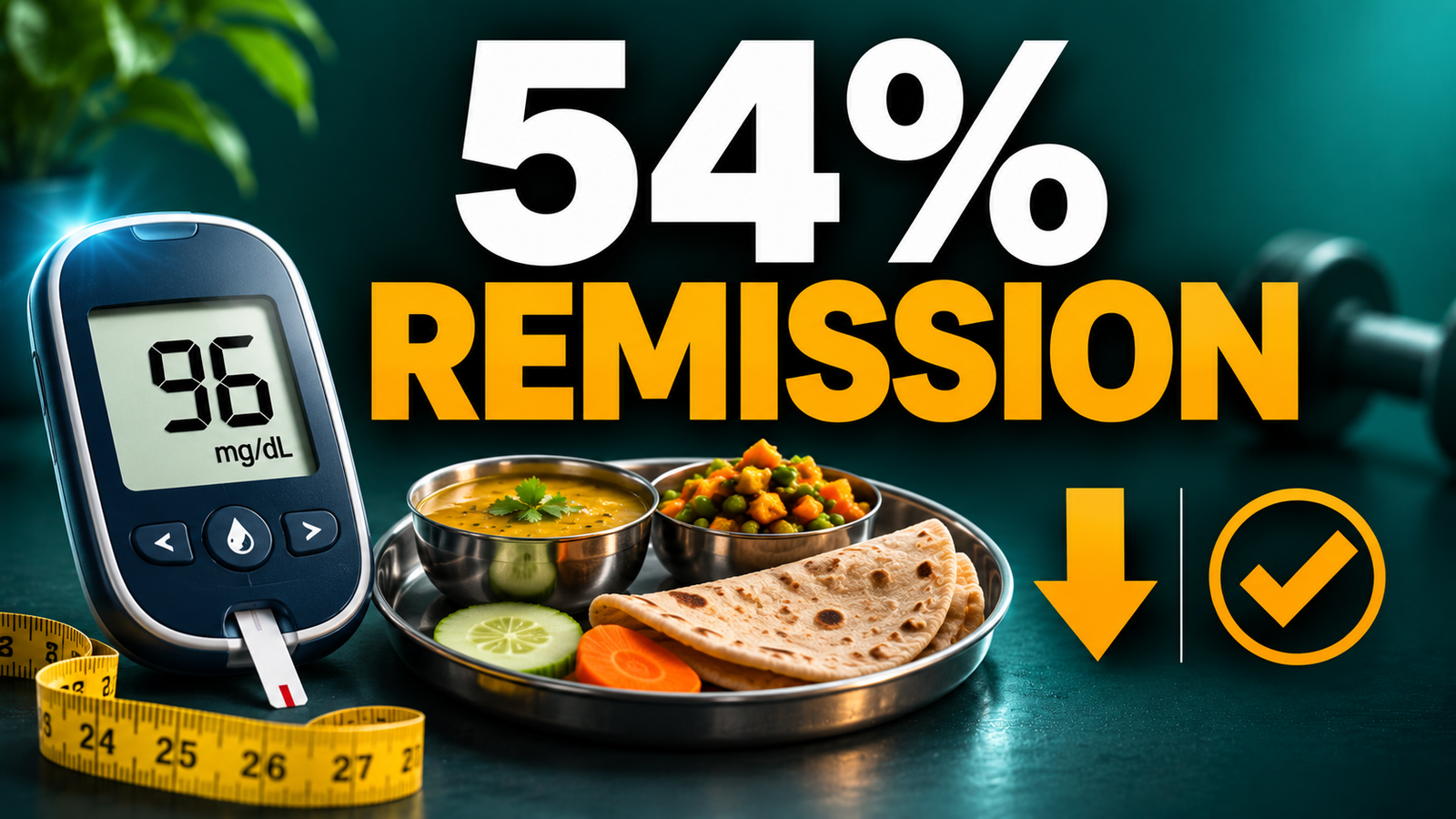
Type 2 diabetes remission means your blood sugar returns to a non-diabetic range and stays there for at least three months without diabetes medicines. It is not the same as a cure. According to a Science Daily headline, 54% of participants in a trial reached remission within six months, but a single percentage tells you little until you know who was studied, what they did and how long the result lasted.
This guide explains the term, the usual way remission is measured, why a six-month figure has limits, and which questions are worth taking to your doctor. It is general information, not medical advice.
Key takeaways
- Remission usually means an HbA1c below 6.5% for at least three months with no glucose-lowering medicines.
- Remission is not a cure: the condition can return, so regular testing continues.
- A 54% result describes one group of trial participants, not a promise for every person with type 2 diabetes.
- Do not stop or change any medicine on your own. Any change belongs in a conversation with your doctor.
What is type 2 diabetes remission?
In type 2 diabetes, the body either does not make enough insulin or does not respond to it well, so sugar builds up in the blood. Remission means that, for a period, the numbers look like those of someone without diabetes, even though you are no longer taking medicines to lower them.
The most widely used definition comes from an international consensus statement backed by the American Diabetes Association and other major bodies, published in 2021. It describes remission as an HbA1c below 6.5% (48 mmol/mol) measured at least three months after stopping glucose-lowering drugs. HbA1c is a blood test that reflects your average blood sugar over roughly the past two to three months.
Notice what the definition leaves out. It does not say the diabetes is gone for life, and it does not say your risk has vanished. That is why many doctors prefer the word remission over reversal or cure.
What did the 54% trial result actually say?
The only source we have for this article is a Science Daily headline: type 2 diabetes breakthrough as 54% achieve remission in just six months. The headline gives us a percentage and a time frame. It does not give us the trial's size, the participants' age, the treatment used, or how remission was defined.
So we will not guess at those details. What we can do is explain how to read a result like this. If you open the full report, these are the things to look for.
- The definition of remission. Was it HbA1c below 6.5% off all medicines for three months, or a looser standard such as a lower HbA1c while still on a drug?
- The starting point. People who were diagnosed recently and have a shorter history of diabetes tend to do better than people who have lived with it for 10 or 15 years.
- The intervention. Was it a very low-calorie diet, medicines, surgery, or a mix? Each carries different costs, side effects and practicality.
- The comparison. Was there a control group receiving usual care?
- The follow-up. Six months shows an early result. It does not show whether people stayed in remission at one year or three.
How do trials measure remission?
Most trials rely on the HbA1c test, sometimes backed by fasting blood glucose. The key detail is the washout period. To count as remission, a person must have been off glucose-lowering medicines for a set time, often three months, before the test.
If a trial counts people who reached a good HbA1c while still taking medicine, that is better described as good control, not remission. Both are good outcomes, but they are different outcomes. When you read a headline, check which one is being reported.
Trials also differ in who is counted. Some report results for everyone who started, while others report only those who finished. People who drop out are often those for whom the programme was not working, so a result limited to completers can look better than the real-world picture.
A worked example: what does 54% mean in numbers?
Percentages hide the size of the group. Take a purely illustrative example, not the real trial's numbers. Suppose 200 people with type 2 diabetes start a programme and 108 reach remission.
108 divided by 200 is 0.54, or 54%. That leaves 92 people who did not reach remission. Now suppose 20 people dropped out before the six-month test and were not counted. If only the 180 who finished were counted and 108 of them reached remission, the figure would be 108 divided by 180, which is 60%. If all 200 are counted, it is 54%.
The same group of people produces two different headlines depending on who is included. This is why the phrase to look for in any study is how participants who left early were handled.
Can type 2 diabetes be reversed?
For some people, yes, in the sense of remission. The best-known earlier example is the DiRECT trial in the UK, which used a structured low-calorie diet programme in people recently diagnosed with type 2 diabetes. It reported remission in about 46% of participants at 12 months and about 36% at 24 months. The drop between those two figures shows why follow-up length matters.
Studies like this link remission closely to weight loss, especially losing a substantial amount of body weight and keeping it off. Fat stored in the liver and pancreas appears to affect how well the body handles sugar, and reducing it can let insulin work better. Doctors still debate the exact mechanisms, and results vary from person to person.
Reversal is therefore a reasonable word for a condition that can go quiet, but a poor word for a condition that can return. If you regain weight or if the underlying insulin problem persists, blood sugar can rise again.
Remission vs cure vs control: what is the difference?
| Term | What it means | Medicines? | Can it return? |
|---|---|---|---|
| Good control | Blood sugar kept in target range | Usually yes | Yes, if treatment lapses |
| Remission | HbA1c below 6.5% for at least 3 months | No glucose-lowering drugs | Yes |
| Cure | Condition permanently gone | No | Not used for type 2 diabetes |
The word cure appears rarely in diabetes medicine for exactly this reason. A related debate exists in other conditions, as we explain in our piece on what a functional cure means for hepatitis B, where the label also describes a state rather than a permanent end to the disease.
Myth vs fact
Myth: If 54% reach remission, there is a 54% chance it will work for me.
Fact: That figure describes a specific group under specific conditions. Your chances depend on how long you have had diabetes, your weight, your medicines, your other health conditions and what programme you follow.
Myth: Remission means I can eat anything again.
Fact: Remission is usually maintained through the same changes that produced it. Going back to old habits is a common reason for relapse.
Myth: If my sugar is normal, I can stop my tablets.
Fact: Normal readings may be the result of the tablets. Stopping them without medical advice can be unsafe.
Who may be more likely to reach remission?
Research generally points to a few patterns. People diagnosed more recently, people who can lose a significant amount of weight, and people whose bodies still make a fair amount of insulin tend to be more likely to reach remission. People with longer-standing diabetes or who need insulin often have lower rates.
These are tendencies, not rules. Body type also matters: people in South Asia can develop type 2 diabetes at lower body weights than people in Western countries, so remission pathways may not look the same. Ask your doctor whether the research they are citing included people like you.
What should you ask your doctor?
Bring this list to your next appointment. It works for any news story about remission.
- Based on my HbA1c, how long I have had diabetes and my medicines, is remission a realistic goal for me?
- What would count as remission for me, and how often would we test?
- If I try a weight-loss programme, which medicines would need adjusting, and when?
- What warning signs mean I should stop and call you?
- If I reach remission, how often should I still have eye, kidney and foot checks?
- Do drugs like the newer weight-loss injections have a place in my plan, and what would they cost over a year?
On the last point, our guide to GLP-1 drug prices in India, generics and insurance explains how the costs of this drug class work, which matters if your doctor raises it.
A note for readers in India
India has one of the largest populations of people living with diabetes in the world, so remission headlines draw wide attention here. Most of the large remission trials were run in the UK, Europe or the US, with diets and healthcare systems that differ from ours. A low-calorie plan built around Indian meals, which are often rich in rice, roti and other carbohydrates, needs to be designed with a qualified dietitian rather than copied from a foreign study.
Do not rely on social media diets or supplements that claim to reverse diabetes in weeks. If a plan asks you to drop your medicines first, treat that as a red flag and speak to your own doctor.
Common mistakes when reading a remission headline
- Treating a six-month result as a lifetime result.
- Assuming remission and cure mean the same thing.
- Ignoring how many people started and how many were counted.
- Stopping medicines because a news story sounded hopeful.
- Skipping regular check-ups after one normal reading.
FAQ
What is diabetes remission meaning in simple words?
It means your blood sugar has returned to a non-diabetic range without glucose-lowering medicines for at least three months. The tendency toward diabetes can remain, so monitoring continues.
Does the 54% trial mean over half of all people with type 2 diabetes can reverse it?
No. The figure applies to the people in that trial, under its conditions and definition. Different people and programmes can give very different results.
Can type 2 diabetes be reversed permanently?
Remission can last for years in some people, but it is not guaranteed to be permanent. Weight regain and the passage of time can bring blood sugar back up, which is why doctors keep testing.
Should I stop my diabetes medicine if my sugar is normal?
Not on your own. Normal readings are often a sign the medicine is working. Only your doctor can decide whether and how to reduce or stop treatment safely.
How is remission different from being pre-diabetic?
Pre-diabetes describes blood sugar higher than normal but below the diabetes threshold in someone who may never have had diabetes. Remission describes someone who previously had type 2 diabetes and now tests below the diabetes threshold off medicines.
Bottom line
Remission is a real and encouraging outcome for some people with type 2 diabetes, but it is a state to maintain, not a finish line. A 54% headline is worth reading for the detail behind it: how remission was defined, who took part and how long the result lasted. Before you change anything, book a conversation with your doctor, take the question list above and ask for your latest HbA1c so you both start from your own numbers.