Content options
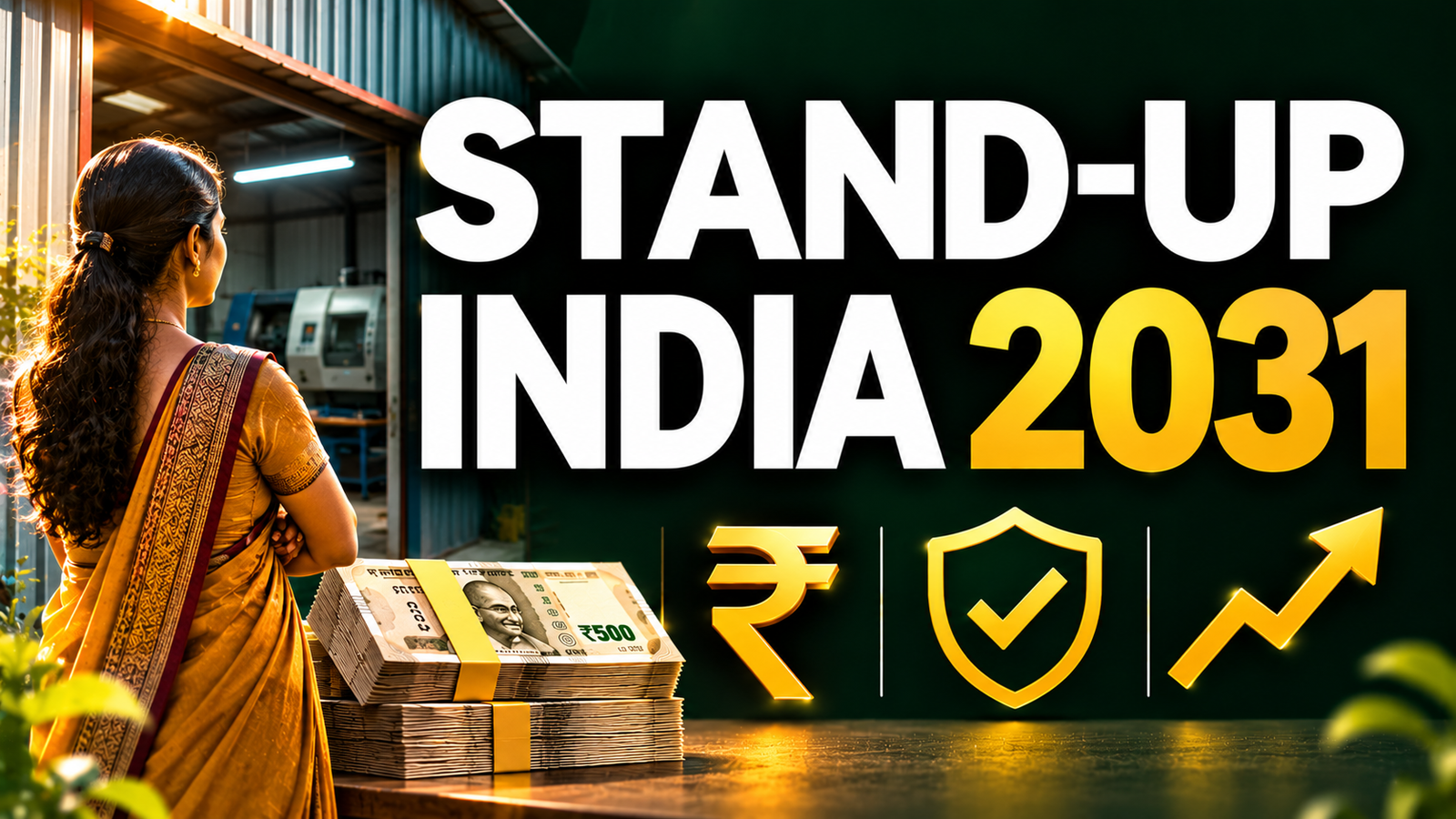
The Union Cabinet has extended the Stand-Up India scheme until 31 March 2031 and approved a corpus of ₹4,111 crore, according to reports in Business Standard and other outlets. If you are a woman or belong to a Scheduled Caste (SC) or Scheduled Tribe (ST) and want to start a first-time business, the scheme still gives you a route to a bank loan. You apply through a scheduled commercial bank, either at a branch or through the Stand-Up Mitra portal.
The news reports cover the extension itself. They say little about who actually qualifies or what the bank will ask for. This guide fills that gap, so you can check your eligibility before you walk into a branch.
Key takeaways
- Stand-Up India is for women and SC/ST entrepreneurs setting up a new (greenfield) business, with composite bank loans typically between ₹10 lakh and ₹1 crore.
- Reports say the scheme now runs to 31 March 2031, backed by a ₹4,111 crore corpus. The reports we have seen do not say that the eligibility rules changed.
- Keep identity, address, caste certificate (if applicable), business registration and a project report ready before applying.
- The bank decides on the loan. Applying does not guarantee approval.
What did the Cabinet decide on Stand-Up India?
According to reports, the Cabinet extended the scheme till 31 March 2031 and approved a ₹4,111 crore corpus. The scheme began in April 2016, and its earlier validity was till 2025, so this extension keeps it running for several more years.
The reports we reviewed do not explain in detail what the corpus will be used for, and we will not guess. The official Cabinet release on the Press Information Bureau website is the place to confirm the exact wording. Until banks issue fresh instructions, the existing scheme guidelines remain the best guide to how loans work.
Who is eligible for Stand-Up India?
The scheme targets people who are usually under-served by formal credit. The commonly stated conditions are these:
- Who: an Indian citizen who is a woman, or belongs to an SC or ST community. You do not need to be both.
- Age: at least 18 years.
- Type of business: a greenfield enterprise, meaning a first-time venture, in manufacturing, services, trading or agriculture-allied activities.
- Companies and firms: if the business is not an individual proprietorship, at least 51% of shareholding and controlling stake must be held by an eligible SC, ST or woman entrepreneur.
- Credit record: you should not be a defaulter to any bank or financial institution.
Existing businesses that simply want more working capital generally do not qualify, because the scheme is aimed at new units. If you already run a shop and want to open a second, different venture, ask the bank how it treats that case.
How much can you borrow and on what terms?
Stand-Up India offers a composite loan, which means one loan covers both the term loan (machinery, shop fit-out) and working capital (stock, raw material). The figures below reflect the scheme as it has been described in the past. Confirm them with your bank, since the extension news does not mention changes.
| Feature | Typical position |
|---|---|
| Loan size | ₹10 lakh to ₹1 crore |
| Type | Composite loan (term loan plus working capital) |
| Repayment | Up to 7 years, with a possible moratorium of up to 18 months |
| Your contribution | Bank usually expects at least 10% of project cost from you |
| Interest rate | Set by the bank, with a cap linked to its benchmark rate |
| Lenders | Scheduled commercial banks |
The loan is not a grant and not a subsidy. You repay it with interest, and the bank will assess your project like any other business loan.
A worked example with rupee numbers
Say Meena, a first-time entrepreneur in Gujarat, wants to open a small packaged-snacks unit. Her project report puts the total cost at ₹40 lakh, including machines, a rented shed fit-out and initial raw material.
Assume the bank finances up to 75% of the project, with Meena bringing 10% and the rest coming from another source such as a state subsidy or additional own funds. These splits are illustrative, since each bank sets its own margin.
- Bank loan: 75% of ₹40,00,000 = ₹30,00,000
- Meena's own contribution: 10% of ₹40,00,000 = ₹4,00,000
- Balance from a subsidy, other scheme or extra savings: 15% of ₹40,00,000 = ₹6,00,000
If the loan carried an assumed 10% annual interest over 7 years (84 months), the standard EMI formula gives roughly ₹49,800 a month. The working: monthly rate 0.10 ÷ 12 = 0.00833, and EMI = 30,00,000 × 0.00833 × (1.00833)84 ÷ [(1.00833)84 − 1], which comes to about ₹49,800. A moratorium would change this, and the real rate will differ.
The useful test is simple. Before applying, check that your expected monthly profit can cover an EMI of that size with room to spare.
Which documents should you keep ready?
Banks vary, but most ask for a similar set. Gather these before your first visit so the file does not stall.
- Identity proof: Aadhaar and PAN card of the applicant, and of each partner or director for firms and companies.
- Address proof: Aadhaar, voter ID, passport, electricity bill or similar.
- Caste certificate: for SC or ST applicants, issued by the competent authority.
- Business proof: Udyam registration, GST registration if applicable, trade licence or shop establishment certificate, whichever suits your activity.
- Project report: a short plan with costs, expected sales, profit and how you will repay.
- Quotations: from suppliers for machinery, equipment or major purchases.
- Constitution documents: partnership deed, or incorporation papers for a company.
- Bank statements and photographs: recent statements, and passport-size photos.
Banks may also ask for a property or premises document such as a rent agreement, and for collateral or a guarantee depending on the amount. Ask this question directly at the branch.
How do you apply, step by step?
- Check your eligibility. Confirm you are a woman or SC/ST applicant and that your business is new.
- Prepare the project report. A clear, realistic plan matters more than a long one. If you are unsure, a local MSME facilitation centre or a chartered accountant can help.
- Register on the portal. The official Stand-Up Mitra portal at standupmitra.in lets you register and submit a loan application online. You can also walk into a bank branch directly.
- Choose your route. The three usual routes are the portal, a direct visit to any scheduled commercial bank branch, or the Lead District Manager (LDM) of your district. Each district has an LDM from its lead bank who can guide first-time applicants.
- Submit documents and meet the banker. Expect questions about your experience, your plan and your contribution.
- Wait for appraisal. The bank checks your credit record and project. Ask for a timeline in writing and follow up politely.
- Sanction and disbursal. If approved, you sign the loan agreement and the bank releases funds, often in stages tied to purchases.
What mistakes cause applications to fail?
Most rejections come from preventable gaps. Here are the common ones.
- Applying for an existing business. The scheme is for new ventures, and a running unit is likely to be turned away.
- A vague project report. Numbers that do not add up make bankers doubt the plan.
- No own contribution ready. Arriving without the margin money signals weak commitment.
- Old defaults. A past unpaid loan or card dues can block approval, so check your credit report first.
- Relying on agents. The portal and bank branch are free to use. Never pay anyone for a guaranteed sanction.
Myth vs fact
Myth: The extension means everyone gets a loan of up to ₹1 crore.
Fact: It means the scheme stays open until 2031. Each loan is approved or declined by a bank after appraisal.
Myth: Only SC/ST men and women can apply.
Fact: Women from any category are eligible, as are SC and ST applicants of any gender.
Myth: The loan comes with a government subsidy.
Fact: Stand-Up India is a bank loan scheme. Subsidies, where available, come from separate central or state programmes. If you are exploring those, our guide to another state government scheme's eligibility and application steps shows how to check official criteria.
A note for applicants in Gujarat and elsewhere
Banks across Gujarat, as in other states, handle Stand-Up India through their regular business loan teams. Your district LDM is usually the most practical first contact, because they know which branches actively lend under the scheme. State-level MSME or SC/ST/women development schemes may sometimes be combined with it, so ask about that when you meet the banker.
If you are deciding where to keep your own margin money before it is needed, our comparison of post-tax returns on ₹1 lakh across FD, mutual funds and gold may help. For a general habit of verifying government announcements before acting, see how we break down scheme changes and what to check.
Frequently asked questions
Until when is Stand-Up India valid now?
According to reports, the Union Cabinet extended it until 31 March 2031. Confirm the exact wording in the official release or your bank's notice.
Can a man from a general category apply?
Not individually. The scheme is for women and SC/ST entrepreneurs. A man from the general category could be involved only in a firm where an eligible person holds the required majority and controlling stake.
Do I need collateral?
It depends on the bank and loan size. The scheme has had a credit guarantee arrangement in the past, but banks may still ask for security. Ask your branch what it requires for your amount.
Can I apply online?
Yes, you can register and submit an application on the Stand-Up Mitra portal. The final decision and the loan agreement still happen with the bank.
What is the ₹4,111 crore corpus?
Reports say the Cabinet approved this amount alongside the extension. The detailed purpose is best checked in the official Cabinet release, since the news summaries we saw do not spell it out.
Bottom line
If you are a woman or SC/ST entrepreneur with a genuinely new business idea, the extension to 2031 gives you time to prepare properly rather than rush. Start this week by writing a one-page project report, collecting the documents above and checking your credit record. Then register on standupmitra.in or visit your district LDM. Verify current loan limits and terms with the bank, and talk to a chartered accountant if your project is complex.